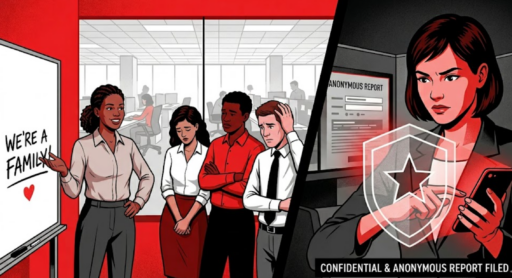
When “We’re a Family Here” Is Actually a Red Flag for a Toxic Workplace Culture
It sounds warm. It sounds safe. And if you’ve heard it from a manager or executive, chances are it was meant sincerely. But in the world of workplace compliance and ethics, the phrase “We’re a family here” has earned a complicated reputation — and for good reason.
When leaders use family-style language to define workplace culture, they’re often trying to build loyalty, camaraderie, and commitment. Those are admirable goals. The problem is that the unintended consequences can quietly dismantle the very thing every ethical organization depends on: the willingness of employees to speak up when something is wrong.
In organizations where a cult-of-personality leader or deeply insular culture has taken hold, employees don’t just stay quiet because they’re afraid of being fired. They stay quiet because they’ve been conditioned to equate silence with loyalty — and to equate speaking up with betrayal.
That’s not a healthy family. That’s a compliance crisis waiting to happen.
The Psychology Behind the Problem
Family dynamics are powerful precisely because they’re emotionally charged. When an organization successfully cultivates a family-like atmosphere, employees feel a sense of belonging and identity tied to the group. That’s not inherently bad. But when the “family” framing is used — consciously or not — to discourage dissent, the results can be damaging.
In tightly knit or high-loyalty cultures, employees are consistently less likely to provide upward feedback or challenge leadership decisions — not because they lack the insight, but because the social cost of speaking up feels too high. The fear isn’t always retaliation in a formal sense. It’s the quieter fear of being seen as disloyal, of being pushed to the outside of a group that has defined itself as family. Meanwhile, Gartner research shows that only about 41 percent of workplace misconduct is reported globally — leaving the majority of incidents unaddressed, unresolved, and often recurring.
The mechanics are straightforward: when employees define themselves as part of a “family,” reporting a colleague or supervisor doesn’t feel like an act of integrity — it feels like an act of betrayal. Over time, this dynamic becomes self-reinforcing. Problems go unreported. Bad behavior normalizes. The culture that was supposed to make people feel supported ends up making them feel trapped.
As Psychology Today recently noted, the mechanics that produce unhealthy organizational cultures exist on the same continuum as more extreme group dynamics: “The way to spot a cult is by its mechanics, not by its outcomes. By the time the outcome is visible, it’s already too late.” Dissent gets punished. Agreement gets rewarded. And speaking up becomes the riskiest thing an employee can do.
Warning Signs That Culture Is Suppressing Truth
Not every organization that uses family-style language has a toxic culture. The warning signs are in the behaviors, not the words. Watch for these patterns:
- Loyalty is measured by agreement, not performance. Employees who raise questions or concerns are labeled “negative” or “not a culture fit.”
- There is a prominent, charismatic leader whose authority feels unquestionable. Decisions made by this person are rarely challenged, even when they appear problematic.
- Reporting concerns is actively discouraged. Employees are told to “work things out internally” or to “take care of it in the family.”
- Long-tenured employees are treated as insiders while newer employees feel pressure to conform before they feel safe to speak.
- Your ethics hotline goes unused — not because nothing is happening, but because employees don’t believe it’s truly anonymous or safe.
- Leaders respond defensively to reports rather than with curiosity and openness.
Any one of these signs alone might be explainable. Several together suggest a culture that has quietly built walls around accountability.
The Real Cost of Organizational Silence
The stakes here aren’t abstract. When employees don’t feel safe reporting, fraud, harassment, safety violations, and misconduct go undetected for months or years. According to the ACFE’s 2024 Report to the Nations, the single most effective fraud detection method is tips from employees — accounting for 43 percent of all cases discovered, more than three times the next most common method. Organizations that have anonymous reporting hotlines see fraud losses that are 50 percent smaller than those without.
Those numbers represent real money, real careers, and real harm to real people. And the cultures most likely to suppress those tips are the ones where loyalty has been redefined as silence.
The connection between culture and reporting behavior isn’t just theoretical. We’ve explored this dynamic in depth in our article on toxic positivity in the workplace, where “good vibes only” cultures create nearly identical suppression effects — a different phrase, the same dangerous outcome.
What a Healthy Speak-Up Culture Actually Looks Like
Genuine belonging and psychological safety are not the same thing as a “family culture.” Organizations that get this right don’t ask employees to choose between loyalty and integrity. They make it clear that speaking up – through any channel – is itself an act of loyalty.
Here’s what distinguishes a truly healthy speak-up culture:
- Leadership models vulnerability. Leaders openly acknowledge mistakes and course-correct in ways that are visible to the organization.
- Reporting is normalized, not celebrated as heroism. Employees shouldn’t feel they’re taking extraordinary risks just to report a concern. It should feel routine.
- There is a genuinely independent reporting channel. An internal HR inbox is not sufficient. True anonymity requires a third-party provider with no connection to internal management structures.
- Reports are acknowledged and acted upon. Even when an investigation concludes that a report was unfounded, the employee who filed it should receive confirmation that their concern was heard and reviewed.
- Managers are trained to receive feedback without retaliation. The response to a report matters as much as whether the report was filed.
Culture is not built by slogans. It’s built by what happens when someone tells the truth — and what happens next.
The Role of an Independent Hotline
No matter how committed an organization is to open communication, there will always be concerns that employees are unwilling to raise through direct channels. That’s not a failure of culture. It’s a predictable human response to risk. An independent, anonymous ethics and fraud reporting hotline exists precisely for those moments — giving employees a safe, confidential way to get a concern into the right hands.
When the hotline is operated by a third party, it functions as a neutral intake channel, completely separate from the organization’s internal structure. Employees can report without fear that their identity will be exposed to a manager, HR department, or executive. The third-party provider receives and documents the report — but it is the organization’s own leadership and management that reviews it, determines next steps, and drives any resulting action. The hotline creates the on-ramp. The organization does the work.
That separation matters enormously in cultures where loyalty has become entangled with silence. Internal reporting mechanisms — whether an open-door policy, an HR inbox, or an internal ethics committee — will always carry the implicit weight of the culture around them. A third-party channel sits outside that weight entirely. In “family” cultures especially, that psychological distance is often the difference between a concern being raised and a concern being buried. For organizations serious about building a genuine speak-up environment, independent intake isn’t a nice-to-have. It’s the structural foundation everything else rests on.
Frequently Asked Questions
Is a family-style workplace culture always problematic?
Not inherently. The issue isn’t the language — it’s the behavior. When “family culture” is used to build genuine belonging and trust, it can be a strength. It becomes dangerous when it’s used — intentionally or not — to suppress dissent, discourage reporting, or protect individuals in leadership from accountability.
What if employees simply don’t use our hotline?
Low hotline utilization is often a symptom of a culture problem, not a hotline problem. If employees don’t believe reports will be confidential, or if they’ve seen what happens to people who spoke up in the past, they’ll stay silent regardless of what tools are available. Culture and infrastructure have to work together.
How do we know if our culture is actually suppressing reporting?
Audit your reporting rates over time. Talk to employees through anonymous engagement surveys. Review how your organization has responded to past reports — and whether that response was visible enough to signal that speaking up leads somewhere. If your hotline has gone unused for months, that’s worth investigating.
Can a company have a strong culture AND a strong speak-up environment?
Absolutely — and the best organizations do both. Strong culture and strong accountability are not in conflict. In fact, organizations with genuinely healthy cultures tend to have higher reporting rates because employees trust that their concerns will be taken seriously. The goal isn’t to eliminate belonging; it’s to make sure belonging doesn’t come at the price of honesty.
Is Your Organization Ready for an Honest Conversation?
If the ideas in this article resonate — or if they’ve surfaced some questions about your own organization’s reporting culture — we’d welcome the conversation. Red Flag Reporting works with organizations of all sizes to provide independent, confidential ethics and fraud reporting services. Contact us today to learn how we can help.
Provider: Red Flag Reporting | Services: Ethics & Fraud Hotline Services
Reach Us
Red Flag Reporting
P.O. Box 4230, Akron, Ohio 44321
Tel: 877-676-6551
Fax: 330-572-8146