Remote Work Compliance Risks: When Culture Drifts Out of View
Executives who lead distributed teams often learn the hard way that management by proximity doesn’t survive the transition to a screen. Walking the floor, catching a raised eyebrow in a hallway, or noticing when someone goes quiet in a meeting are all cues that depend on physical presence. As hybrid and remote arrangements have become permanent fixtures of the modern workplace rather than pandemic-era exceptions, the remote work compliance risks tied to distributed leadership are becoming clearer — and they extend well beyond IT security and multi-state payroll registrations.
For compliance and HR leaders, the core question isn’t whether remote work causes more misconduct. It’s whether leadership can still see, hear, and respond to it when the workforce is no longer in one place.
Physical Distance Creates Real Remote Work Compliance Risks
In June 2022, Gartner, Inc. reported that the rate of compliance reporting had fallen roughly 30% from pre-pandemic levels, and that remote employees observed about 11% less misconduct overall than their in-office peers. On the surface, that sounds like good news. But Gartner’s research also found the picture is more complicated: while observed misconduct around travel, gifts, and entertainment had fallen (largely because there’s simply less opportunity for it), bullying, intimidation, and unwanted behavior were up roughly 7% for remote workers, and misuse of time and company assets was up about 3%.
In other words, some categories of misconduct are becoming less visible to leadership even as they persist — or grow — out of view. That combination is exactly what should concern compliance officers: less reporting doesn’t mean less risk. It often means less visibility.
Four Blind Spots Remote Leaders Should Watch For
1. Invisible Misconduct
Behaviors that used to be visible around a shared office now happen in private messages, side channels, or simply behind a camera that’s turned off. That can include how a manager speaks to a direct report in a one-on-one call, who gets quietly excluded from informal side conversations or key meeting invites, inappropriate comments buried in a chat thread, unauthorized use of AI tools on sensitive company data, or expense submissions that are harder to cross-check without an in-office routine. Leaders can no longer rely on incidental observation as an early warning system.
2. Culture Drift
Without shared physical space, team-level norms can quietly diverge from the values stated in the employee handbook. One team may maintain a strong, well-modeled culture of respect and accountability, while another — reporting to a different manager, meeting less often, communicating mostly asynchronously — drifts toward a very different set of unwritten rules. Leadership at the top may have no idea the gap exists until it shows up in an exit interview or a formal complaint.
3. Manager Isolation
Middle managers are typically the first people employees turn to with a concern, but many managers of remote and hybrid teams are themselves disconnected from senior leadership, without a clear playbook for what to do when something is brought to them.
Gallup’s research on hybrid work (“Hybrid Work in Retreat? Barely,” Gallup, 2025) identifies trust as the central challenge of managing distributed teams: only about half of managers who oversee remote employees strongly agree they trust their teams to be productive, and a similar share of employees say they feel trusted by their manager. Gallup’s study doesn’t measure misconduct reporting directly, but it stands to reason that where underlying trust is thin, it’s harder for a manager to have the kind of direct conversation that surfaces a concern early.
4. Reporting Barriers
In an office, an employee who isn’t sure whether something is worth reporting might mention it to a trusted colleague at lunch, or notice a poster by the breakroom reminding them how to file a concern. Remote employees don’t have those informal, ambient reminders. This is a reasonable extension of the drop in reporting Gartner documented, though it’s a mechanism the study itself didn’t isolate. If the only reporting path an employee knows of is “talk to my manager” — and the manager is part of the problem, or simply hard to reach — concerns can go unspoken indefinitely.
What Leaders Can Do About It
Addressing remote work compliance risks doesn’t require reversing hybrid or remote policies. It requires closing the visibility gap those policies create.
- Build deliberate communication rhythms. Gallup’s research found that employees who receive timely, consistent communication about what’s happening on their team — regardless of where they’re working — report substantially higher trust in their manager. Predictable check-ins do real compliance work, not just morale work.
- Let teams set shared norms rather than leaving location and availability entirely to individual discretion. Gallup found that employees on teams that jointly decide their hybrid schedule are far more likely to view their work arrangement as fair than those whose schedule is set unilaterally by either the employee or the employer alone.
- Train managers specifically for remote supervision. Recognizing a disengaged or distressed employee over a video call is a different skill than reading body language in person, and most managers have never been taught how to do it.
- Reinforce psychological safety on a recurring cadence, not just once during onboarding. A speak-up culture that’s mentioned once in a new-hire orientation fades quickly for employees who rarely set foot in an office.
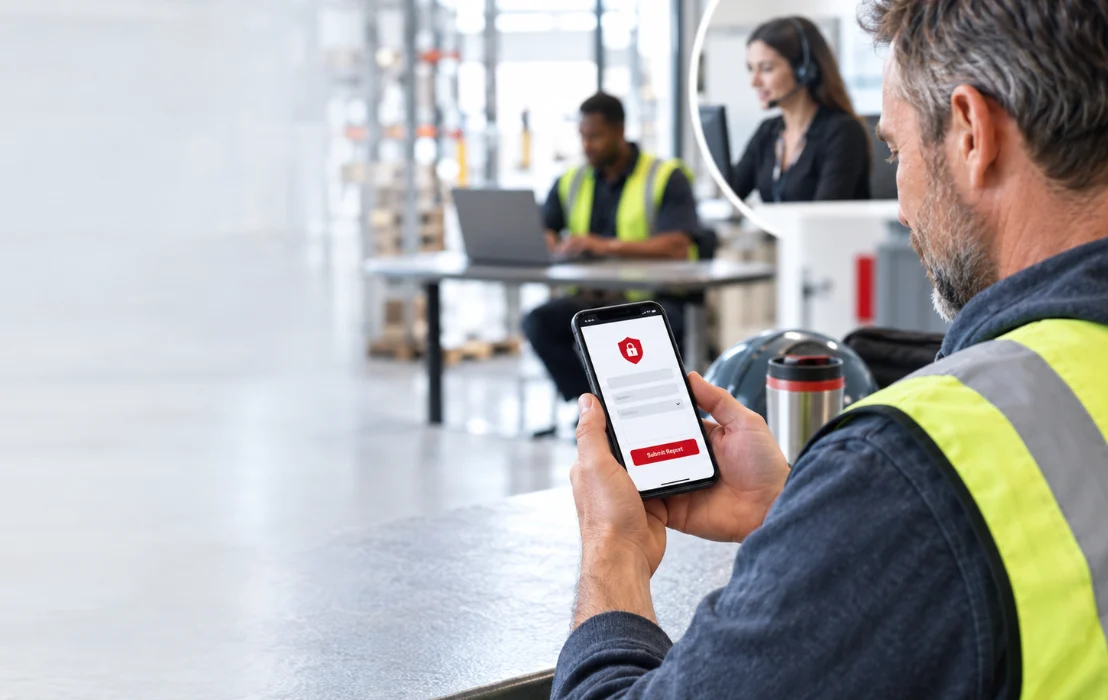
- Offer a reporting channel that doesn’t depend on physical proximity. An independent, anonymous hotline gives every employee — whether they’re down the hall or three time zones away — the same ability to raise a concern without needing to catch the right person at the right moment.
That last point is where an independent reporting channel earns its keep. Red Flag Reporting provides organizations with a confidential, always-available intake channel and case management tools, so a remote employee has exactly the same access to speak up as someone sitting in the corporate office. Reports are routed to each client’s designated internal contacts according to that organization’s own procedures — the organization’s own personnel handle the follow-up and any resulting decisions. For a distributed workforce, that consistency matters: the reporting channel shouldn’t depend on where an employee happens to be sitting.
For most organizations, remote work compliance risks don’t arrive as a single dramatic event. They build gradually, through reduced visibility, uneven team norms, and fewer everyday chances for a concern to surface on its own. The organizations that manage this well are the ones that build communication, accountability, and reporting systems deliberately, so they work just as effectively online as they always did in person.
Frequently Asked Questions
Does remote work actually increase compliance risk?
Not uniformly but remote work compliances risks are real. Gartner’s research shows remote employees observe less misconduct overall, largely due to reduced opportunity for issues like travel and expense abuse. However, categories such as bullying, intimidation, and misuse of company time and assets have increased for remote workers, even as overall reporting rates have fallen.
Why do employees report less misconduct when working remotely?
Remote work changes how employees experience their organization’s culture, communication, and reporting systems. Without daily in-person contact, informal cues that might otherwise prompt someone to speak up disappear, and the perceived cost of reporting can start to outweigh the perceived benefit — a pattern consistent with Gartner’s finding that reporting rates have dropped even where misconduct persists.
What is “culture drift” in a remote or hybrid organization?
Culture drift describes the gradual divergence of a team’s actual, lived norms from the values an organization states officially. It tends to happen unevenly across a distributed organization, since each team is shaped largely by its own manager and its own communication habits rather than by consistent, shared physical experience.
How can organizations close the compliance gaps created by remote leadership?
Consistent communication, manager training tailored to remote supervision, team-level norm-setting, and recurring reinforcement of a speak-up culture all help remote work compliance risks. Just as important is making sure every employee, regardless of location, has access to an independent and anonymous way to raise a concern.
Can an anonymous hotline help address remote work compliance risks?
Yes. An independent, third-party hotline removes physical proximity as a precondition for speaking up. It gives remote and hybrid employees a confidential channel that doesn’t rely on being in the right place, at the right time, with the right person.
Distance Should Never Silence a Concern
Whether your team works from a single office or across a dozen time zones, an independent reporting channel makes sure distance never determines whether a concern gets heard. Reduce your remote work compliance risks by contacting us.
Contact Red Flag Reporting today to talk through your organization’s reporting needs →
Reach Us
Red Flag Reporting
P.O. Box 4230, Akron, Ohio 44321
Tel: 877-676-6551
Fax: 330-572-8146