
What is Compliance Risk? Definition, Examples, and How Organizations Manage It
Every organization — regardless of size, sector, or mission — operates within a web of laws, regulations, and internal policies. When those obligations go unmet, the consequences can be severe. Understanding compliance risk is the first step toward preventing the legal penalties, financial losses, and reputational damage that result from non-compliance.
What is Compliance Risk?
Definition and overview
Compliance risk is the exposure an organization faces to legal or regulatory penalties, financial losses, and reputational harm when it fails to follow applicable laws, regulations, industry standards, or its own internal policies. It is sometimes referred to as regulatory risk or legal risk, though each of these terms carries slightly different emphasis.
In practice, compliance risk is not a single, isolated threat. It encompasses everything from a payroll miscalculation that violates wage-and-hour law to a data breach caused by inadequate security controls to an employee harassment claim that was never properly investigated. What unites these scenarios is that they all stem from a failure — intentional or not — to meet an obligation the organization was expected to uphold.
The Committee of Sponsoring Organizations of the Treadway Commission (COSO) has published specific guidance on applying its Enterprise Risk Management framework to compliance risk — a recognition that managing compliance risk requires the same disciplined, organization-wide approach as managing financial or operational risk.
How compliance risk differs from other business risks
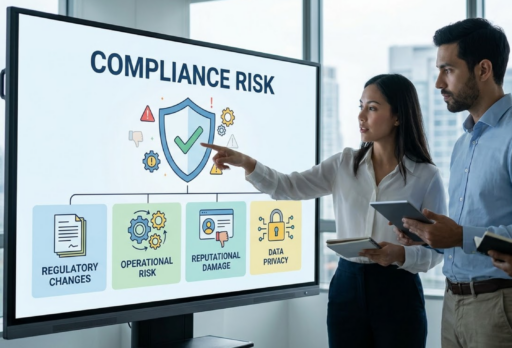
Compliance risk is often confused with operational risk, financial risk, and reputational risk — and with good reason, because the four are deeply interconnected. A compliance failure frequently triggers all three. But compliance risk is distinct in that it originates from a specific source: the failure to follow an external rule or internal standard. Operational risk arises from process failures, system breakdowns, or human error that may have nothing to do with legal or regulatory obligations. Financial risk relates to market conditions, credit exposure, and liquidity. Reputational risk is often a downstream consequence of compliance failures rather than an independent category.
Understanding compliance risk on its own terms allows organizations to assign accountability clearly, allocate resources strategically, and build controls that address the actual root cause of exposure.
Common Sources of Compliance Risk
Regulatory and legal requirements
The most direct source of compliance risk is the external regulatory environment. Federal, state, and local governments impose requirements across virtually every function of organizational life — employment practices, environmental impact, financial reporting, workplace safety, data privacy, anti-corruption, and more. Industry-specific regulators add further layers: the Securities and Exchange Commission for publicly traded companies, the Office of Civil Rights for healthcare entities, banking regulators for financial institutions, and so on.
The challenge is not just knowing the rules today — it is keeping pace with how those rules evolve. Regulatory change is constant. New legislation, updated agency guidance, and shifting enforcement priorities can alter an organization’s compliance obligations with little warning, creating risk where none previously existed.
Internal policy violations
Compliance risk does not come only from external sources. Many organizations create significant exposure through violations of their own internal policies — codes of conduct, conflicts-of-interest policies, procurement rules, data handling standards, and human resources procedures. When employees deviate from established internal standards, the organization may face liability even if no specific law was broken, and it almost certainly faces liability if a law was.
Internal policy violations are often the earliest detectable signal of a deeper compliance problem. An employee who circumvents an approval process, a manager who conducts an informal performance review to avoid documentation, or a vendor relationship that bypasses standard procurement — each of these may seem minor in isolation, but they commonly precede more serious violations.
Weak oversight or monitoring
Even well-designed compliance programs fail when they are not actively monitored. Organizations that lack ongoing compliance oversight — regular audits, data analysis, reporting channels, and management review — often discover problems only after they have caused significant damage. Weak controls create conditions in which violations can persist undetected for months or years, compounding both the harm and the eventual cost of remediation.
Examples of Compliance Risk in Organizations
Financial reporting violations
Public companies and nonprofits alike face significant compliance risk in the area of financial reporting. Inaccurate or incomplete disclosures, improper revenue recognition, failure to maintain adequate internal controls over financial reporting, and non-compliance with Generally Accepted Accounting Principles (GAAP) or International Financial Reporting Standards (IFRS) can all trigger regulatory action, restatements, investor lawsuits, and reputational damage. The Sarbanes-Oxley Act of 2002 formalized many of these obligations for public companies, and enforcement has remained vigorous in the decades since.
Workplace misconduct or ethical violations
Harassment, discrimination, retaliation, and violations of workplace safety regulations represent some of the most common and costly compliance risks organizations face. Beyond the direct costs of litigation and settlement, workplace misconduct erodes organizational culture, drives employee turnover, and draws regulatory scrutiny. Organizations that lack clear anti-harassment policies, anti-retaliation protections, and confidential reporting mechanisms are both more likely to experience these violations and less likely to catch them early enough to limit the damage.
Data privacy or regulatory compliance failures
The regulatory landscape for data privacy has become increasingly demanding. GDPR in Europe, CCPA in California, HIPAA for healthcare data, and a growing number of state-level privacy laws impose specific obligations around how personal data is collected, stored, shared, and protected. A failure to comply — whether through a cyberattack enabled by inadequate security controls or through unauthorized data sharing — can result in substantial fines and lasting harm to customer trust.
How Organizations Identify and Assess Compliance Risk
Conducting compliance risk assessments
A compliance risk assessment is a systematic process for identifying, analyzing, and prioritizing the compliance risks an organization faces. It involves mapping the organization’s activities against applicable legal and regulatory requirements, evaluating existing controls, and identifying gaps where exposure is greatest. Effective risk assessments are not one-time events; they are updated regularly and revisited whenever significant organizational or regulatory changes occur.
The goal of a risk assessment is to give compliance officers and leadership a clear, prioritized picture of where the organization is most vulnerable — so resources can be directed where they will have the greatest impact.
Monitoring regulatory changes
Staying current with the regulatory environment is a continuous obligation. Organizations should have processes in place to track legislative developments, regulatory guidance, enforcement trends, and industry-specific standards. Many compliance functions subscribe to regulatory update services, maintain relationships with outside counsel, and participate in industry associations as part of this effort. The objective is to identify emerging compliance risks before they materialize into violations.
Internal audits and compliance monitoring
Internal audit functions play a critical role in ongoing compliance oversight. Regular testing of internal controls, transaction reviews, policy adherence checks, and compliance monitoring data all feed into an organization’s understanding of its risk profile. The findings of internal audits should be reported to senior leadership and, where appropriate, to the board or audit committee, with clear action plans for remediation.
Managing and Reducing Compliance Risk
Building strong compliance programs
An effective compliance program is the foundation of risk management. At minimum, it should include a written code of conduct, clear and accessible policies covering key risk areas, regular training for employees at all levels, designated compliance leadership, and mechanisms for ongoing monitoring and reporting. Senior leadership’s visible commitment to compliance — what the Treadway Commission describes as “tone at the top” — is among the most powerful predictors of program effectiveness.
Compliance programs should also be sized to the organization’s risk profile. A healthcare organization handling sensitive patient data faces different compliance priorities than a manufacturing company subject to environmental regulations, even if both need robust general frameworks in place.
Encouraging employee reporting
Much of the most important compliance information in any organization is held by the people closest to daily operations — employees, contractors, vendors, and other stakeholders. Ensuring that these individuals have a safe, accessible, and confidential way to raise concerns is essential to early detection. Fear of retaliation is the primary reason people stay silent when they observe potential violations. Organizations that actively protect reporters and make reporting easy — through anonymous hotlines, web portals, and clear anti-retaliation policies — surface issues far earlier than those that rely solely on management escalation or formal audits.
For a deeper look at how documentation and reporting practices support organizations during regulatory scrutiny, see our post on The Paper Trail of Integrity: How Hotline Compliance Documentation Supports Organizations During Federal Oversight.
Investigating and resolving compliance concerns
When a potential violation is identified — whether through a hotline report, an audit finding, or a management observation — the organization’s response matters as much as the detection itself. Thorough, timely, and well-documented investigations demonstrate that the compliance program is functioning as intended, and that the organization takes its obligations seriously. Regulators consistently treat evidence of an effective compliance response as a mitigating factor when assessing penalties.
How Reporting Systems Help Reduce Compliance Risk
Providing safe channels for reporting concerns
An independent, confidential reporting channel — commonly called a compliance hotline or ethics hotline — allows employees, vendors, and other stakeholders to report concerns without fear of retaliation. When operated by a third-party provider, these systems offer anonymity that internal reporting mechanisms often cannot provide, increasing both the volume and candor of reports received. Organizations with robust reporting channels consistently identify compliance issues earlier, when they are smaller and less costly to resolve.
Using case management tools to track investigations
Once a concern is reported, the organization’s ability to track, assign, investigate, and resolve it efficiently is critical. Case management systems create a structured record of every report and every action taken in response — documentation that is invaluable both for internal accountability and for demonstrating program effectiveness to regulators, auditors, and governing boards. Without this infrastructure, even well-intentioned organizations struggle to close the loop on compliance concerns in a consistent and defensible way.
| STEPS TO REDUCE COMPLIANCE RISK
1. Conduct regular, documented compliance risk assessments 2. Establish clear, accessible policies across key risk areas 3. Train employees on ethical standards and their reporting obligations 4. Provide confidential, anonymous reporting channels 5. Track and resolve every investigation through a case management system |
| Ready to Reduce Compliance Risk in Your Organization?
Red Flag Reporting provides independent hotline and case management solutions that help compliance teams identify and address issues early — before they become costly violations. |