
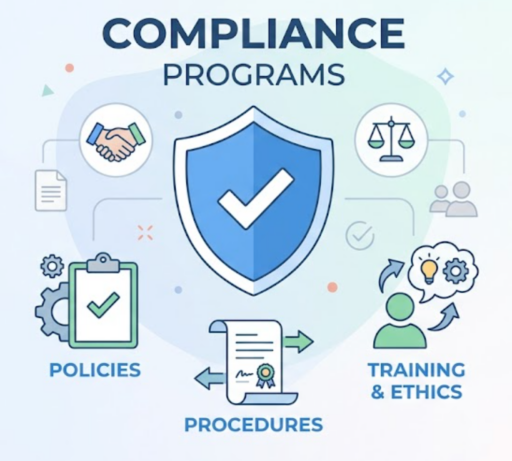
Organizations of every size face legal, regulatory, and ethical expectations that don’t manage themselves. A compliance program is the structured infrastructure that ensures they don’t have to figure it out ad hoc — and that when something goes wrong, there’s a system in place to catch it early.
What is a Compliance Program?
A compliance program is a structured set of policies, procedures, and internal controls designed to help an organization follow applicable laws, regulations, and ethical standards. It translates broad legal and regulatory obligations into day-to-day operational practices — giving employees clear guidance on expected behavior and giving leadership visibility into whether those expectations are being met.
While the specific shape of a compliance program varies by industry, size, and regulatory environment, the underlying purpose is consistent: to prevent misconduct before it occurs, detect problems when they arise, and respond effectively when they do.
What a compliance program typically includes
Most compliance programs are built around a common set of functional components. Together, these elements create an interconnected system — one where policies are communicated, risks are identified, conduct is monitored, and employees have a safe path to raise concerns.
| Key Elements of an Effective Compliance Program
Regulatory guidance consistently points to these core building blocks: |
|
| ✓ Written policies and procedures | ✓ Internal auditing and compliance reviews |
| ✓ Compliance training and employee education | ✓ Investigation and corrective action processes |
| ✓ Risk assessments and ongoing monitoring | ✓ Designated compliance leadership |
| ✓ Confidential reporting channels (ethics hotlines) | ✓ Disciplinary standards and enforcement |
Why Compliance Programs Are Important
Organizations don’t build compliance programs simply to check a regulatory box. At their best, these programs reflect a genuine commitment to operating with integrity — and they produce measurable benefits that extend well beyond avoiding fines.
Preventing legal and regulatory violations
The most direct function of a compliance program is risk reduction. By establishing clear policies, training employees on their obligations, and monitoring adherence, organizations can meaningfully reduce the likelihood of regulatory violations, fraud, discrimination, and other legal exposure. When violations do occur, a documented and functioning compliance program is a recognized factor in how regulators and courts assess the organization’s culpability.
Strengthening organizational ethics and accountability
A compliance program communicates organizational values in concrete, actionable terms. It establishes that certain behaviors are expected — and that others will not be tolerated — regardless of seniority or business pressure. Over time, this consistency builds an ethical culture where employees understand the rules and feel confident that they apply equally to everyone.
Protecting reputation and stakeholder trust
Regulatory violations and ethical scandals rarely stay contained. They surface in press coverage, regulatory filings, and employee conversations — often long after the underlying conduct has been resolved. Organizations with mature compliance programs are better positioned to detect and address issues internally earlier — potentially reducing the risk of escalation into public crises, preserving the trust of customers, investors, regulators, and employees.
Key Elements of an Effective Compliance Program
Regulatory agencies and courts evaluating corporate compliance programs consistently return to the same question: is this program real, or is it a paper exercise? The following elements distinguish programs that actually function from those that exist only in policy documents.
Written policies and procedures
Every effective compliance program starts with clear, written policies that tell employees what is expected of them. These policies cover areas like conflicts of interest, anti-bribery and corruption, data privacy, workplace conduct, and industry-specific obligations. Critically, they must be accessible — written in plain language and easy to locate — and reviewed regularly to reflect changes in law, regulation, and business operations.
Compliance training and employee education
Policies are only useful if employees understand them. A strong compliance program includes regular training tailored to the roles and risk profiles of different employee groups. New-hire orientation, annual refresher training, and role-specific modules for higher-risk functions each play a part. Training should go beyond rule-recitation to help employees recognize gray areas and understand the reasoning behind compliance obligations.
Risk assessments and monitoring
Compliance risk isn’t static. Organizations face different exposures depending on their industry, geography, business model, and workforce. An effective compliance program includes formal risk assessments to identify where the organization is most vulnerable, followed by monitoring activities — audits, data reviews, transactional testing — designed to detect problems in those areas. The results of monitoring should feed back into program improvements on an ongoing basis.
Reporting channels such as ethics hotlines
Employees are often the first to observe misconduct or potential violations. An effective compliance program gives them a safe, confidential way to report concerns — without fear of retaliation. Ethics hotlines, web-based reporting portals, and other anonymous channels serve this purpose. The existence of an accessible reporting mechanism signals organizational commitment to accountability and surfaces issues that might otherwise go undetected until they become serious problems.
Investigation and enforcement procedures
Receiving a report is only the beginning. Organizations need documented processes for triaging, investigating, and resolving compliance concerns in a timely and consistent way. This includes determining who conducts investigations, how findings are documented, what corrective actions are available, and how disciplinary decisions are made. Consistent enforcement — applied fairly regardless of an employee’s position — is essential to a program’s credibility.
Regulatory Guidance on Compliance Programs
Several key regulatory frameworks shape what organizations are expected to build — and how their compliance programs will be evaluated if things go wrong.
| U.S. Sentencing Guidelines
Chapter Eight provides explicit criteria for an “effective compliance and ethics program.” Organizations meeting these standards may receive reduced culpability scores in federal criminal proceedings, creating a direct legal incentive to invest in program quality. |
DOJ Guidance
The Department of Justice publishes guidance on evaluating corporate compliance programs, updated regularly to reflect enforcement priorities. Prosecutors use this framework to assess whether a program was genuinely effective at the time of a violation. |
Industry Regulators
Sector-specific regulators — including the SEC, OIG, FINRA, and HHS — publish their own compliance program expectations. Healthcare, financial services, and government contractors each face overlapping obligations requiring tailored program elements. |
| Key takeaway: Regulatory bodies don’t just ask whether a compliance program exists — they ask whether it works. Program design, resourcing, leadership support, and responsiveness to detected issues all factor into that evaluation. |
The Role of Reporting Systems in Compliance Programs
“Most compliance issues don’t begin as full-blown crises. They start as observable concerns that someone, somewhere, noticed — and either did or didn’t have a way to report.”
Why confidential reporting channels matter
Multiple studies have shown that tips from employees, vendors, and other insiders are among the most common ways organizations first learn about fraud, safety violations, and other compliance failures. When employees don’t have a reliable, confidential way to surface concerns — or don’t trust that doing so is safe — those issues tend to go unreported until they become significantly more costly to address.
A confidential reporting channel changes that dynamic. It lowers the personal risk of speaking up and creates a formal path for concerns to reach the people responsible for acting on them.
Encouraging employees to report concerns
The existence of a reporting channel is necessary but not sufficient. Employees need to know about it, trust it, and believe their reports will be taken seriously. Effective compliance programs promote their reporting channels actively, train employees on how and when to use them, and demonstrate — through action — that reports lead to genuine investigation and appropriate follow-through. A non-retaliation policy, clearly communicated and consistently enforced, is foundational to building that trust.
Supporting investigations and case management
When a report comes in, the work is just beginning. Organizations need the ability to track each report from intake through resolution, document investigative steps, assign responsibility, and maintain records that can withstand regulatory scrutiny. Case management tools purpose-built for compliance investigations provide the structure and audit trail that informal processes lack — and can help compliance teams identify patterns across multiple reports over time.
How Red Flag Reporting Supports Compliance Programs
Red Flag Reporting provides the reporting infrastructure and case management tools that compliance programs need to function effectively — giving employees a secure way to raise concerns and giving compliance teams the systems to act on them.
Secure whistleblower and ethics hotline services
Red Flag Reporting operates confidential ethics hotlines and web-based reporting portals that employees, vendors, and other stakeholders can use to report concerns 24 hours a day, seven days a week. Reports can be submitted anonymously, and the platform is designed to protect reporter identity throughout the process. Multilingual support and accessibility options help ensure that reporting is available to all members of an organization’s workforce.
Case management tools for compliance investigations
Every report received through Red Flag Reporting’s platform is tracked from intake to resolution within a structured case management system. Compliance teams can assign cases, document investigative steps, record findings, and log corrective actions — all within a single, auditable workflow. This significantly reduces the risk of reports falling through the cracks and creates a documentation record aligned with what regulators and auditors typically expect.
Configurable reporting and escalation processes
Red Flag Reporting’s platform can be configured to reflect an organization’s specific escalation paths, notification preferences, and category structures. Reports can be routed automatically based on subject matter and/or location — helping ensure that HR, legal, compliance, or other relevant functions receive timely notification. Built-in reporting and analytics give compliance leaders visibility into report volume, resolution timelines, and emerging trends across the organization.
Implementation and next steps
Implementing or upgrading a compliance reporting infrastructure doesn’t require a lengthy deployment process. Red Flag Reporting works with organizations to configure a solution that fits their structure and can be made operational quickly — whether they’re building a compliance program from the ground up or strengthening an existing one.
| Ready to Strengthen Your Compliance Program?
Learn how Red Flag Reporting’s hotline and case management solutions can help your organization detect issues early and build a stronger culture of accountability. |
© 2026 Red Flag Reporting. All rights reserved.