AI Workplace Fraud Is Here — Deepfake Invoices, AI Phishing, and Synthetic Identity Fraud Are Targeting Your Organization Right Now
The fraud threat landscape has fundamentally changed. The same AI tools powering productivity across corporate America are now being weaponized by criminals — used to clone executive voices, generate fake invoices that pass visual inspection, craft personalized phishing emails, and build entirely fictitious employee identities. If your organization hasn’t updated its fraud prevention protocols to account for AI workplace fraud, the question is no longer whether you’ll be targeted. It’s whether you’ll recognize the attack before the wire transfer clears.
For organizations that operate anonymous ethics and fraud reporting hotlines, this shift is urgent. The more sophisticated and convincing the attack, the more critical it becomes that employees feel empowered — and safe — to report something that feels off, even when they can’t articulate exactly why.
The Scale of AI Workplace Fraud
The numbers are staggering and accelerating. Fortune reported in March 2026 that:
“Deepfake fraud drained $1.1 billion from U.S. corporate accounts in 2025, tripling from $360 million the year before.” — Fortune, March 2026
That’s not a cybersecurity statistic buried in a technical report. That is real money leaving real company bank accounts — authorized by real employees who believed they were following legitimate instructions. The attacks are no longer theoretical edge cases. They are happening every day, across organizations of every size and sector.
Meanwhile, PYMNTS Intelligence found in its April 2025 Invoice-to-Pay Automation Tracker® that 90% of U.S. firms were targeted by cyberfraud in 2024, with business email compromise attacks affecting 63% of companies — a 103% increase from the prior year. AI phishing is not a fringe threat. It is a mass-scale operation.
Three AI Workplace Fraud Tactics Every Employee Should Know
- Deepfake Invoices and Executive Impersonation
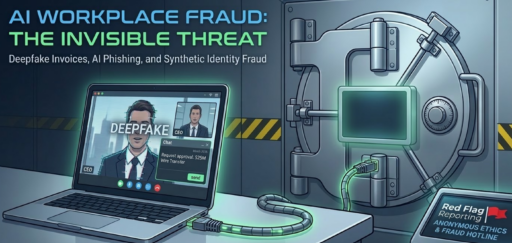
In early 2024, British engineering firm Arup lost over $25 million when a finance employee joined a video conference call with what appeared to be the company’s CFO and several senior colleagues — all of whom turned out to be AI-generated deepfakes. The employee completed 15 wire transfers before the fraud was discovered. Arup’s global chief information officer, Rob Greig, told The Guardian that the number and sophistication of attacks had been rising sharply — a sentiment echoed by fraud analysts across the industry.
This is the defining case of AI workplace fraud because it illustrates how completely the social contract of a normal business interaction can be fabricated. The meeting format felt routine. The faces were familiar. The authority was clear. Everything was fake. AI deepfake invoice fraud works precisely because it exploits trust in normal processes — video calls, email approvals, verbal authorizations — that employees have no reason to second-guess.
- AI-Generated Phishing
Traditional phishing emails were relatively easy to spot — awkward phrasing, generic greetings, obvious grammatical errors. That era is over. Today, over 82% of phishing emails are created with AI assistance, allowing fraudsters to craft convincing, personalized messages up to 40% faster than before. The result is that 78% of people open AI-generated phishing emails, and 21% click on the malicious links inside them.
AI phishing can now reference real internal projects, use an employee’s actual name and title, mimic the writing style of a known colleague or executive, and arrive at psychologically optimal moments. Sift’s Q2 2025 Digital Trust Index found that GenAI-enabled scams rose 456% between May 2024 and April 2025. No filter, no firewall, and no spam detector is catching all of them. Human judgment — and a culture where employees feel safe reporting suspicious communications — remains the last line of defense.
- Synthetic Identity Fraud
Synthetic identity fraud is the most insidious of the three because it is the hardest to detect and often has no direct victim to raise the alarm. Fraudsters construct entirely fictitious personas by combining a real Social Security number — often belonging to a child, an elderly person, or a dormant account holder — with fabricated names, addresses, and biographical data. Generative AI makes the fake documents, the deepfake selfies, and even the synthetic social media footprint that makes the persona appear legitimate.
According to Sift’s research, breached personal data surged 186% in just the first quarter of 2025, providing fraudsters with abundant raw material. In the workplace context, synthetic identity fraud can manifest as fake vendors in the accounts payable system, ghost employees on payroll, or fabricated contractors billing for work never performed. Because no real person is being impersonated, no real person files a fraud report — making anonymous internal reporting systems one of the few mechanisms that can surface these schemes before they cause catastrophic losses.
Why AI Workplace Fraud Is Especially Hard to Detect
Traditional fraud training tells employees to watch for inconsistencies — a strange tone in an email, an unfamiliar sender address, a request that seems slightly off. Generative AI eliminates most of those inconsistencies. A Pindrop report revealed that deepfake fraud attempts rose by more than 1,300% in 2024, jumping from roughly one attempt per month to seven per day. And the human eye is no match for what is being generated.
A peer-reviewed meta-analysis published in Computers in Human Behavior Reports (Diel et al., December 2024) synthesized 56 studies involving 86,155 participants and found that human deepfake detection accuracy is statistically no better than a coin flip — 55.54% overall, with video specifically at 57.31%. More damning: when measured by odds ratio, participants had only a 39% chance of correctly identifying a deepfake, which is actually worse than random chance. The researchers concluded that human detection performance is consistently at chance level across all media types.
Put plainly: even a trained, vigilant employee watching a deepfake video call is nearly as likely to miss the fraud as catch it. Awareness alone is not a defense strategy.
“Fraudsters are evolving at warp speed — so our solutions must evolve even faster.” — Pindrop Chief Product Officer Rahul Sood, June 2025
A Deloitte survey found that one in four organizations had experienced at least one deepfake incident targeting financial and accounting data — yet only 29% of firms had taken steps to protect themselves, and 46% lacked any mitigation plan at all. The awareness gap is real, and it is expensive.
How to Stop AI Workplace Fraud Before It Costs You
Defense against AI fraud requires a layered approach — because single-layer defenses consistently fail against AI-powered attacks. No one procedure, policy, or technology is sufficient on its own. The following measures, applied together, create meaningful friction against even sophisticated attacks.
Verify through a second channel. Any request for a wire transfer, vendor payment, or sensitive data change — particularly when it arrives via email or video — should require independent verification through a pre-established, out-of-band channel. A phone call to a known number. A callback through an internal system. Not a reply to the same email thread.
Implement code-word protocols for high-stakes requests. Departments handling financial transactions should establish pre-agreed internal verification phrases that cannot be replicated by an AI that has only analyzed public or email data. SecureWorld’s analysis of deepfake enterprise fraud recommends pre-agreed internal verification phrases and call-back rules to validate real-time requests.
Train employees on AI phishing — specifically. General cybersecurity awareness training is no longer sufficient. Employees need specific education on AI-generated phishing, voice cloning, deepfake video calls, and synthetic identity tactics. More than half of business leaders report their employees have had no training on identifying deepfake attacks.
Audit vendor and payroll records for anomalies. Ghost employees and synthetic vendors don’t file complaints. Regular audits of vendor onboarding documents, payroll records, and contractor credentials — with attention to inconsistencies in digital footprints — can surface synthetic identity fraud before losses escalate.
Strengthen your internal reporting culture. Employees are often the first to notice something feels wrong — a vendor they don’t recognize on an invoice, a colleague who seems to have been added to payroll without any onboarding, an executive communication that feels slightly off in tone. An anonymous, confidential reporting hotline gives those employees a safe channel to act on that instinct without fear of embarrassment or retaliation. In an environment where human visual and auditory detection fails 75% of the time, empowering employees to report suspicion of AI workplace fraud is not optional. It is essential.
The Bottom Line on AI Workplace Fraud
Generative AI has transformed fraud from an opportunistic crime into a scalable, industrial operation. Deloitte’s Center for Financial Services projects that AI-enabled fraud losses in the United States will reach $40 billion by 2027. Fortune reported in January 2026 that 72% of business leaders believe AI-enabled fraud and deepfakes will be among their top operational challenges in 2026.
Organizations that treat this as purely an IT problem will lose. The most effective defense is organizational — a combination of procedural controls, specific employee training, and a workplace culture where people feel safe reporting anomalies before they become catastrophes. That’s exactly what a well-designed ethics and fraud reporting hotline is built to support.
If your organization doesn’t have an anonymous reporting channel, or if your existing one hasn’t been promoted as a resource for AI fraud concerns, now is the time to change that. The fraudsters have already updated their playbook. Your employees deserve the same.
About Red Flag Reporting
Red Flag Reporting provides anonymous ethics and fraud hotline services to organizations across industries. Our platform makes it easy for employees to report fraud, waste, abuse, and ethical concerns — confidentially, 24/7. Learn more at redflagreporting.com
Sources
- Fortune: Boards aren’t ready for the AI age — deepfake fraud drained $1.1B from U.S. corporate accounts in 2025 (March 2026)
- PYMNTS Intelligence: From Faked Invoices to Faked Executives, GenAI Has Transformed Fraud (April 2025)
- Pindrop: 2025 Voice Intelligence & Security Report — 1,300% Surge in Deepfake Fraud (June 2025)
- Incode: Top 5 Cases of AI Deepfake Fraud From 2024
- Sift: Q2 2025 Digital Trust Index — AI Fraud Data and Insights
- Fortune: Consumers lost $12.5 billion to fraud — AI-powered scams set to explode in 2026 (January 2026)
- Diel et al.: Human performance in detecting deepfakes — A systematic review and meta-analysis of 56 papers, Computers in Human Behavior Reports (December 2024)
Reach Us
Red Flag Reporting
P.O. Box 4230, Akron, Ohio 44321
Tel: 877-676-6551
Fax: 330-572-8146