Wearable Technology for Workplace Safety: 8 Powerful Tools Protecting Workers
Wearable technology for workplace safety is changing the way employers protect their people. Imagine a world where technology is not just a tool, but a wearable companion that enhances our daily lives. From smartwatches that offer information at a glance, to fitness trackers that help us lead healthier lives, to virtual reality headsets that transport us to different worlds, wearable technology is already a part of our everyday existence. But its potential extends beyond personal use. In the realm of occupational safety and health, wearable technology is emerging as a revolutionary force, transforming the way we approach workplace safety.
What Is Wearable Technology?
Simply put, wearable technology refers to devices that are worn on one’s body to track, analyze, and share data. Wearable technology is sometimes discussed in the context of the wearable internet of things (WIoT), meaning that these devices are connected to one another and the internet in order to share data and information. Real-time data collection and communication via the WIoT opens the door to new possibilities in the area of occupational safety and health, and it is the foundation of modern wearable technology for workplace safety.
8 Types of Wearable Technology for Workplace Safety
The wearable technology company, Slate Safety, provides a detailed breakdown of safety-enhancing wearable technology in their blog post “Top Safety Wearable Technology for 2024.” The following includes a brief summary:
Augmented Reality (AR) Glasses: AR glasses can display metrics and data inside the lens, allowing for hands-free access to information. These glasses can also share and display real-time data using cameras. This helps workers and experts to share information and collaborate as situations arise.
Environmental Monitoring: Wearable technology can monitor air quality, temperature, and the presence of contaminants in a worker’s environment. These devices alert workers and supervisors of potential threats, reducing exposure.
Proximity Warning: Proximity warning technology is often used on vehicles, but it can also be worn on one’s body. This technology uses lasers, radio frequency, infrared sensors or Bluetooth to detect when an individual has become dangerously close to a vehicle or another person.
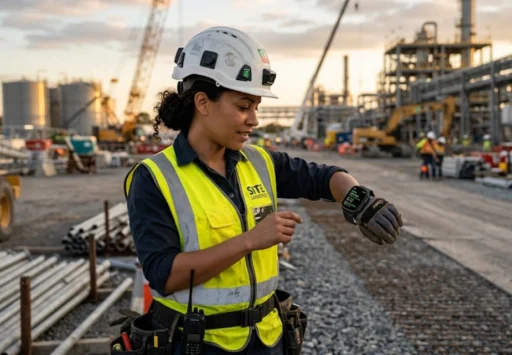
Worker Vital Sign Monitoring: Vital sign monitoring provides the wearer with physiological data such as pulse, oxygen levels, and skin temperature. The device can alert the wearer and supervisors when signs of distress are present. This allows for safer and better-informed decision making.
Lone Worker Monitoring: This wearable technology improves the safety of individuals working alone in remote locations. It can alert supervisors of signs of distress or environmental hazards and can allow for communication between workers and supervisors. This makes it more likely that an emergency response will be initiated in time to avoid injury or death.
Worker Ergonomics: This technology promotes safe body mechanics by monitoring a worker’s lifting and movement. It can act as a coach by alerting workers of unsafe movement as it occurs and can also collect and share data with supervisors to determine trends. This allows employers to pinpoint areas for training and improvement.
Exoskeletons: As futuristic as it sounds, there are currently exoskeletons on the market that support workers in lifting more than they could lift on their own! Mechanical exoskeletons work by redistributing weight, and electronic exoskeletons do some of the lifting to make the worker stronger!
Smart Hard Hats: Smart hard hats provide high tech safety features in addition to serving the purpose of a traditional hard hat. These devices can monitor environmental conditions, movement, and location, and can allow for two-way communication between employees and supervisors.
How Wearable Technology Supports Proactive Safety
Wearable technology improves communication, decision making, and emergency response time as situations arise. While this is important for remedying dangerous situations, one of the best features of wearable technology for workplace safety is that it supports industries in proactively reducing safety risks. HSE People, an online network for the safety and PPE industry, discusses this feature in their article, “Enhancing Workplace Safety: The Vital Role of Wearable Technology.”
The article states, “The data collected by wearable devices offer valuable insights into workplace safety trends, patterns, and areas of concern. By analysing this data, businesses can identify recurring safety issues, assess the effectiveness of existing safety measures, and implement targeted interventions to address potential risks proactively.”
Beyond Safety: Wearables and Workplace Efficiency
Secondary to enhancing workplace safety, wearable technology also plays a role in increasing efficiency. In the article, “How Wearable Technology is Transforming Workplace Safety,” EHS Today explains, “The benefit of WIoT devices is they offer a real-time data stream of all activities on an industrial worksite, manufacturing floor or warehouse. By tracking this data, organizations are able to better understand where inefficiencies or bottlenecks occur and remedy them through better process control.”
What Wearables Can’t Detect
Even the most advanced wearable technology for workplace safety has a blind spot: it measures physical conditions, not behavior or culture. A sensor cannot tell you when a supervisor pressures a crew to skip a safety step, when equipment is being misused, or when an employee notices a hazard but is afraid to speak up. That is why wearables work best alongside a confidential safety hotline that gives employees a secure way to report concerns, anonymously if they choose.
Conclusion
In conclusion, wearable technology for workplace safety is not just a trend, but a significant step forward in enhancing workplace safety and efficiency. From AR glasses to smart hard hats, these devices provide real-time data, proactive risk reduction, and improved communication. They serve as a bridge between workers and supervisors, fostering a safer and more productive work environment.
The integration of wearable technology into the workplace is a testament to the power of innovation in addressing safety concerns and operational inefficiencies. As we continue to embrace this technology, we can look forward to a future where workplace safety is not just a goal, but a reality. Wearable technology, with its potential to transform industries, is indeed a gamechanger, paving the way for a safer, more efficient, and more connected workplace.
Wearable technology can warn you about a hazard, but your employees are often the first to see the risks no device can measure. Red Flag Reporting’s confidential safety hotline gives them a simple, secure way to speak up, and every report is delivered promptly to your organization so you can act. Contact us today to learn how Red Flag Reporting can strengthen your safety program, with no administrator license fees.
Frequently Asked Questions About Wearable Technology for Workplace Safety
What is wearable technology for workplace safety?
Wearable technology for workplace safety refers to devices worn on the body, such as smart hard hats, AR glasses, vital sign monitors, and environmental sensors, that track, analyze, and share data about a worker’s condition and surroundings. The goal is to spot hazards early and prevent injuries before they happen.
What types of wearable safety devices are available?
Common categories include augmented reality glasses, environmental monitors, proximity warning devices, vital sign monitors, lone worker monitors, ergonomic sensors, exoskeletons, and smart hard hats. Many organizations combine several of these to cover different risks across a worksite.
How does wearable technology help prevent workplace injuries?
Wearables deliver real-time alerts when a worker is exposed to a hazard, shows signs of distress, or moves in an unsafe way. Over time, the data they collect also reveals trends, helping employers target training and fix recurring problems before they lead to injuries.
Does wearable technology raise employee privacy concerns?
It can. Because many devices collect location and physiological data, employers should be transparent about what is collected, why, and how it will be used, and should limit monitoring to legitimate safety purposes. Organizations should also confirm that their programs comply with applicable privacy and employment laws.
Can wearable technology replace a safety hotline?
No. Wearables measure physical conditions, but they cannot report unsafe practices, pressure to cut corners, harassment, or retaliation. A confidential safety hotline gives employees a way to raise those concerns, anonymously if they choose, so the two tools work best together.
Reach Us
Red Flag Reporting
P.O. Box 4230, Akron, Ohio 44321
Tel: 877-676-6551
Fax: 330-572-8146