What Happens After the Report: Evaluating Compliance Management System Workflows, Not Just Intake Forms
Most Compliance Management System Demos Stop Too Early
Sit through enough vendor demos and a pattern emerges. The first two-thirds is intake: the web form, the phone script, the language list, the QR code destined for the break room poster. Then, with a few minutes left, someone clicks into a case file and says, “and of course, everything lands here.” That is where the demo should have focused.
Intake matters. The ACFE’s Occupational Fraud 2026: A Report to the Nations found that 43% of occupational fraud cases were detected by tip, with more than half of those tips coming from employees.
But the same study makes the case for everything that comes after the tip. The median scheme ran 12 months before discovery and cost $104,000. Schemes caught within six months carried a median loss of $40,000; those running more than five years exceeded $1.1 million. The money is not in how fast you collect the report. It is in how fast you work it.
Intake does differ between providers, and those differences matter. Whether a trained live person answers at two in the morning or a voicemail box does. How many languages are genuinely covered by phone and by web, not just claimed. Whether anonymity holds up through the entire process rather than only at the moment of submission. Those are real distinctions and they are worth pressing on.
They are also the part of the evaluation buyers already do well. Intake is visible, demo-friendly, and easy to compare side by side, so it gets the scrutiny. What gets skipped is what a compliance management system does in the 30, 60, and 90 days after a report lands — where the differences between platforms are larger and far harder to see from a demo.
One caution before the walkthrough: workflow depth is not the same as automation depth. The capabilities that matter get a report to the right person quickly, keep an honest record, and leave judgment with your team. Some of what is demonstrated as sophistication is really the vendor making decisions that belong to you, at a price that climbs with every feature.
The U.S. Department of Justice’s Evaluation of Corporate Compliance Programs makes the same point, asking prosecutors to probe the workflow behind the reporting mechanism: “How does the company ensure that investigations are properly scoped? What steps does the company take to ensure investigations are independent, objective, appropriately conducted, and properly documented?” And: does the company have “a process for monitoring the outcome of investigations and ensuring accountability for the response to any findings or recommendations”? Every one of those questions is about what happens after the report.
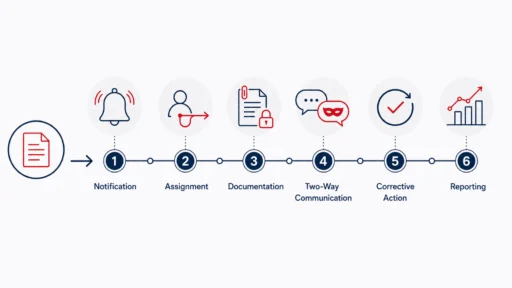
The 6 Stages of a Well-Designed Compliance Case Management Workflow
- Notification and initial assessment
- Case assignment and investigator management
- Investigation documentation and evidence management
- Two-way anonymous communication with the reporter
- Resolution, corrective action, and case closure
- Reporting, trend analysis, and board visibility
Stage 1 — Notification and Initial Assessment
Notification speed is the first place a compliance management system either saves you a week or quietly costs you one.
Where notification is weak, reports sit in a shared inbox waiting to be noticed. The cost is not only delay but inconsistency — the same allegation handled two ways depending on who read it first, the pattern that undermines a program during a regulatory review.
The system’s job here is narrow and important: capture enough structure at intake to describe what was alleged, then put it in front of the right people immediately. Red Flag Reporting alerts a client’s designated recipients within two minutes of receiving a report.
What a compliance management system should not do is decide how serious that report is. Severity and escalation depend on the organization, the people named, and the history behind the allegation — none of which a vendor can reliably encode in advance for every client and scenario. Escalation is a client decision. Treat automated severity scoring as a convenience at best, never as a substitute for the judgment of someone who knows the organization.
Evaluate: How quickly are designated recipients notified, and by what method? Can you control which recipients receive which categories of report? Does the platform leave severity and escalation to your team rather than presuming them?
Stage 2 — Case Assignment and Investigator Management
Assignment is where conflicts of interest either get caught or get baked into the case file.
The non-negotiable is this: a report about a person must never be distributed to that person. Red Flag Reporting’s platform blocks distribution of a report to a recipient when the report concerns that recipient. That single control protects investigation integrity more than most of the automation buyers spend their demo time on.
Beyond it, routing by category or location is genuinely useful and genuinely optional. A multi-site organization benefits from reports reaching a regional compliance lead directly; a fifty-person company with two reports a year does not need to pay for that and should not be told it is mandatory. Ask what a provider offers with and without it, and what each costs — the lower-cost configuration is often the better fit, not a compromise.
Whatever the routing, recipients need the ability to reassign a case manually. Rules cannot anticipate a vacation, a conflict that only surfaces on reading the file, or a matter that belongs with HR rather than legal. A system that routes rigidly and will not let a recipient hand off a case obstructs resolution rather than speeding it.
Visibility belongs here too, at the level a platform can honestly provide: knowing which cases are open and how long they have been open is usually enough to catch a matter that has stalled.
Evaluate: Does the platform prevent a report from reaching a recipient the report names? Is category or location routing available, and at what price point? Can a recipient reassign a case without going back to the vendor? Can you see which cases are open and how long they have been open?
Stage 3 — Compliance Investigation Workflow: Documentation and Evidence
Documentation is where a compliance management system stops being a convenience and becomes a legal risk control.
This is what auditors and regulators examine. They are rarely asking whether you reached the right conclusion; they are asking whether the file shows a defensible compliance investigation workflow — that the allegation was scoped, the scoping decision recorded, the supporting evidence still attached, and the account of what happened intact. A case file assembled from a shared drive, a spreadsheet, and three people’s email archives demonstrates none of that.
Structured documentation means dated investigator notes, records of who was interviewed and when, evidence attached to the case rather than living in someone’s inbox, and a record of the actions taken on the report. Part of that record is client-facing; part sits with the provider and is produced on request. Both count — but know which is which before you need it.
Be realistic about retrieval. Few platforms assemble the report, the evidence, every message, and every case note into a single formatted packet at the press of a button, and a vendor promising one is worth pressing on. The practical question is not whether the file prints in one click, but whether everything you need is in one place, attributable, and retrievable when someone asks.
Evaluate: What is recorded automatically about actions taken on a case, and can the provider produce that record on request? Is evidence stored with the case rather than beside it? If you had to assemble a complete file for outside counsel next week, what would that actually involve?
Stage 4 — Two-Way Communication With the Reporter
This is the most underrated capability in the entire compliance case management process.
Anonymous reports are sometimes thin. “Something is wrong with the invoices in the Dayton office” is a real report, and it is uninvestigable as written. Without a way back to the reporter, the investigator can guess or close the case as unsubstantiated — and the second option teaches the workforce that reporting accomplishes nothing.
Two-way anonymous messaging solves this. Red Flag Reporting’s ethics hotline case management provides anonymous two-way messaging, so investigators can ask follow-up questions and reporters can respond, all without ever revealing the reporter’s identity. One clarifying exchange — which vendor, which month, who approved it — is often the difference between a closed-unsubstantiated file and a substantiated finding with a recoverable loss.
Evaluate: How does a reporter re-enter the conversation, and what if they lose their case key? Does the case file show how many follow-up attempts were made and whether the reporter responded?
Stage 5 — Resolution, Corrective Action, and Case Closure
Closing a case and resolving the underlying problem are two different events, and weaker compliance management systems track only the first.
A well-designed compliance reporting workflow keeps both. The case reaches a substantiation determination, written down with the evidence behind it as a summary of the final outcome rather than a conclusion scattered through months of notes. The case is then marked closed as its own deliberate act, not by going quiet.
Any corrective action that follows — a policy revision, a control change, a training requirement, a disciplinary outcome — belongs in the record with an owner attached. Be skeptical of integration promises here: connecting a compliance platform to unrelated business systems multiplies the places sensitive case data lives and the ways it can leak, and the coordination cost usually outruns the benefit. What matters is not whether corrective action flows automatically into another system, but whether someone can answer “what actually changed?” six months later.
Evaluate: Is there a defined place to record the final outcome, separate from running case notes? Is closing a case a deliberate act with a record behind it? Can outstanding follow-up work be seen in one place?
Stage 6 — Compliance Management System Reporting and Board Visibility
Case counts are not compliance reporting. “We received 42 reports this quarter” tells a board nothing about risk.
Meaningful reporting from a compliance management system answers harder questions: which categories are rising and where; how long cases take from intake to closure and whether that is improving; what proportion are substantiated; whether one facility generates more retaliation concerns than comparable sites. Analytics that surface trends and repeat problem areas turn a case log into a risk instrument.
Then scale that ambition to your volume. An organization fielding several hundred reports a year has patterns worth mining. An organization fielding four does not — trend analysis across four cases is noise dressed as insight, and an analytics tier to produce it is budget that would do more good elsewhere in the program. Ask what reporting is included at each option rather than assuming the richest tier is the right one.
The DOJ asks directly: “How and how often does the company measure the success and effectiveness of its compliance program?” Board-level trend reporting is how larger programs answer that. For a smaller one, an honest quarterly summary of what came in, what was substantiated, and what changed as a result answers it perfectly well.
Evaluate: What reporting is included at the option you are actually buying? Can you segment by location, category, and period? Do you need to? Is the provider recommending analytics you will genuinely use, or selling a tier your caseload cannot fill?
What to Ask in Your Next Compliance Management System Demo
Bring these alongside your intake checklist, and ask the vendor to show you rather than tell you:
- How fast designated recipients are notified after a report is submitted, and by what method.
- What happens when a report names one of those designated recipients.
- An investigator sending a follow-up question to an anonymous reporter, and the reporter answering.
- A recipient reassigning a case to a different investigator without vendor involvement.
- Where the final outcome of a case is recorded, and what marking a case closed actually does.
- The reporting you would take to your audit committee — at the option you are actually buying, not the top tier.
If a vendor can walk through all six live, in your configuration, you are evaluating workflow depth. If the answers arrive as roadmap items, you are still evaluating an intake form. And treat an unqualified yes to all six as its own signal: the honest answer to some of these is “here is what we do, here is what we don’t, and here is what it costs to add.” For a plain-language primer on the underlying technology, see our overview of what a case management system is.
Red Flag Reporting’s compliance management system supports every stage of the post-report workflow — from two-minute notification and conflict-aware distribution through anonymous two-way follow-up, documented resolution, and reporting matched to your caseload. Schedule a demo focused on workflow depth, not just intake.
Frequently Asked Questions About Compliance Management Systems
What happens after a compliance report is submitted?
The report is captured with enough structure to describe what was alleged, and the organization’s designated recipients are notified — quickly on a well-run platform. Those recipients assess severity and decide whether to escalate; that judgment belongs to the organization, not the vendor. An investigator then documents scope, evidence, and interviews, follows up with the reporter through anonymous two-way messaging if details are missing, reaches a substantiation determination, records the final outcome, and closes the case. Any corrective action is tracked with an owner, and the case data supports periodic reporting.
What is a compliance management system?
A compliance management system is a software platform that captures ethics, safety, fraud, and HR concerns and manages them through investigation to resolution. It combines multichannel intake — hotline and web portal — with notification, investigator assignment, documentation and evidence storage, anonymous communication with reporters, corrective action tracking, and reporting. Providers differ on intake — live-operator coverage, genuine language depth, how anonymity is preserved — but they differ far more, and far less visibly, on the depth of the post-report workflow.
How does a compliance case management workflow work?
The compliance case management workflow moves through six stages: notification and initial assessment; case assignment and investigator management; investigation documentation and evidence management; two-way anonymous communication with the reporter; resolution, corrective action, and closure; and reporting, trend analysis, and board visibility. Each stage should leave a record someone can find later, so the organization can demonstrate a consistent process rather than reconstruct one after the fact.
What should I evaluate in a compliance management system demo?
Ask the vendor to address post-report capabilities live: how fast designated recipients are notified, what happens when a report names a recipient, an anonymous follow-up exchange with a reporter, a manual reassignment, where a final outcome is recorded, and the reporting available at the option you are actually buying. Intake deserves scrutiny too — live-operator coverage and real language depth are not universal — but it is the part buyers already examine closely. A demo that spends most of its time on the reporting form is leaving the harder comparison unmade.
How does case management software support compliance investigations?
It enforces consistency and creates a defensible record. Distribution controls keep a report from reaching the person it names. Structured documentation keeps scope decisions, interview records, and evidence in one place rather than scattered across inboxes. Anonymous two-way messaging lets investigators close information gaps that would otherwise force a premature unsubstantiated finding. Together these address what the DOJ’s Evaluation of Corporate Compliance Programs asks about whether investigations are properly scoped, independent, documented, and acted upon.
Reach Us
Red Flag Reporting
P.O. Box 4230, Akron, Ohio 44321
Tel: 877-676-6551
Fax: 330-572-8146