
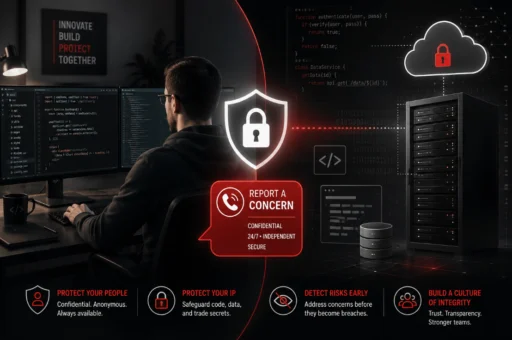
Technology Industry Ethics Hotline: 5 Critical Reasons Tech Companies Can’t Afford to Skip One
Technology companies ship products in weeks, coordinate remote teams across continents, and move valuable source code and customer data constantly through cloud-based systems. That speed is a competitive advantage, but it also creates blind spots where misconduct, data misuse, or IP leaks can go unnoticed until real damage is done.
A technology industry ethics hotline gives software, SaaS, IT services, and hardware companies a confidential, independent channel for employees, contractors, and partners to raise concerns while there is still time to act on them. As an independent hotline and case management provider, Red Flag Reporting builds the reporting and case management services tech companies rely on to keep concerns from festering in the dark.
Why the Technology Industry Needs a Dedicated Ethics Hotline
Tech companies face a compliance landscape that looks different from a traditional manufacturer or retailer. Growth often outpaces the formal policies meant to guide it, and engineering, product, and sales teams routinely handle valuable intellectual property, customer data, and third-party credentials as part of everyday work.
Because so many tech organizations operate as distributed or fully remote teams, the informal, in-person cues that once signaled a problem, such as a tense meeting, a hallway conversation, or a manager overhearing something concerning, simply don’t happen the same way. An ethics reporting hotline for tech companies replaces those missing cues with a deliberate, always-available channel that works whether your team is in one building or spread across a dozen countries.
Unique Compliance Risks in Software, SaaS, and IT Organizations
A handful of risk factors show up again and again in technology companies of every size:
- Rapid scaling: Headcount, contractors, and vendors can double in a year, often faster than onboarding, training, and policy updates can keep pace.
- High-value, portable IP: Source code, algorithms, product roadmaps, and customer data are valuable, digital, and easy to move — a developer sharing a private repository externally or exporting a customer database can happen in seconds and may not be detected until significant damage has already occurred.
- Shadow IT and unauthorized AI use: Employees pasting proprietary code or customer information into public AI tools, or adopting unapproved apps to move faster, can quietly introduce new data-handling and security risks. Our related article, The Rise of Insider AI Shadow IT, looks at how employee-created automations are reshaping this risk.
- Distributed, always-on culture: Remote and hybrid teams reduce the informal moments where problems used to surface naturally.
- Investor and customer scrutiny: Venture investors, enterprise customers, and partners increasingly expect documented ethics and compliance infrastructure as part of due diligence.
Why Early Reporting Matters
Insider risk is one of the most persistent challenges in technology environments, and it isn’t limited to employees with bad intentions — well-meaning staff experimenting with unapproved AI tools or mishandling customer data can create just as much exposure. Research published by ISACA has tracked the rising financial cost of insider-related incidents industry-wide, underscoring why organizations benefit from reporting channels that surface concerns before misconduct escalates — while corrective action is still possible.
5 Reasons a Confidential Reporting Hotline Strengthens Your Technology Organization
- Protects Intellectual Property and Trade Secrets
Source code, proprietary algorithms, and product plans are often a tech company’s most valuable asset. A confidential hotline gives employees and contractors a low-friction way to flag suspected IP theft, unauthorized data access, or code being shared outside approved channels — before it becomes a costly leak.
- Surfaces AI, Data Privacy, and Security Concerns Early
A hotline enables employees to report concerns about data handling, access controls, or AI use — such as a colleague uploading customer records into an unapproved AI assistant — without waiting for a formal security review to catch the issue first.
- Supports a Speak-Up Culture Across Remote and Distributed Teams
When your engineering team is spread across multiple states or countries, a hotline available by phone, web, and app gives every employee the same access to report a concern, regardless of time zone, office location, or reporting relationship to a manager.
For technology organizations seeking a confidential reporting channel and integrated case management tools, Red Flag Reporting provides independent intake services designed to support distributed teams.
- Demonstrates Governance Maturity
Enterprise procurement reviews, SOC 2 audits, vendor due diligence questionnaires, and M&A due diligence increasingly ask about ethics and compliance infrastructure. A documented, independent hotline signals that your organization takes reporting and accountability seriously — well before a customer or acquirer asks.
- Creates a Documented Record for Regulatory and Contractual Requirements
Many technology companies operate under contractual, regulatory, or certification requirements that may include expectations around reporting, compliance, or ethics channels. A hotline paired with case management tools gives your team an organized, timestamped record of what was reported and when, supporting audits and compliance reviews.
Common Issues Reported Through a Technology Industry Ethics Hotline
Employees, contractors, and partners at technology companies use hotlines to report a wide range of concerns, including:
- Unauthorized use of AI tools with sensitive or proprietary data
- Source code or intellectual property theft
- Credential sharing or unauthorized system access
- Misuse or mishandling of customer data
- Vendor kickbacks or undisclosed conflicts of interest
- Harassment or discrimination within remote teams
- Expense or reimbursement fraud
What to Look for in a Technology Industry Ethics Hotline Provider
Not every hotline fits a fast-moving tech organization. Look for a provider that offers true independence from your internal chain of command, multiple reporting channels (phone, web, email, etc.), multilingual support for distributed teams, and case management services that make it easy for your designated internal contacts to track, organize, and follow up on reports.
It’s worth being clear on what a hotline provider does and doesn’t do: Red Flag Reporting captures reports and routes them to the contacts your organization designates, and provides the case management tools your team uses to track and manage those reports — the investigation and resolution of any report always remains with your organization’s own personnel.
An effective confidential reporting channel won’t slow your team down, but it will give you a clearer picture of what’s really happening inside a fast-growing organization. If you’re ready to put a whistleblower hotline for technology organizations in place at your company, contact Red Flag Reporting today — we’re happy to walk through how a hotline and case management program could fit your team.
Frequently Asked Questions
- What is a technology industry ethics hotline?
It’s a confidential, independent channel — typically by phone, web, or email — that lets employees, contractors, and partners at a tech company report concerns like data misuse, IP theft, harassment, or financial irregularities without going through their manager or internal chain of command.
- Do small tech startups need an ethics hotline, or is this only for large companies?
Startups often benefit the most, since formal HR and compliance infrastructure tends to lag behind headcount growth. A hotline gives even a small team a reporting channel that scales as the company grows.
- Can employees submit reports anonymously?
Yes. A hotline provider allows the reporter to choose whether to share their identity or submit anonymously. Anonymous reporters can often continue communicating through the hotline platform to answer follow-up questions without revealing their identity.
- What types of concerns should employees report through a technology industry ethics hotline?
Common examples include unauthorized AI use with sensitive data, source code or IP theft, credential sharing, misuse of customer data, vendor conflicts of interest, harassment, and expense fraud — see the list above for more detail.
- How does a hotline handle a report about IP theft or data misuse?
The hotline captures the report — anonymously, if the reporter chooses — and routes it to the contacts your organization has designated to receive that type of concern. Your own team, using their internal processes, then decides on and carries out any next steps.
- Does the technology industry ethics hotline provider investigate or resolve the reports it receives?
No. A hotline provider like Red Flag Reporting provides the intake and case management tools that make reporting and tracking possible, but investigation and resolution are handled by your organization’s own designated personnel.
- What channels should a technology compliance hotline offer?
Look for a provider offering phone, web, and email reporting, along with multilingual support if your team is distributed across regions — this ensures every employee has equal, convenient access to the hotline.