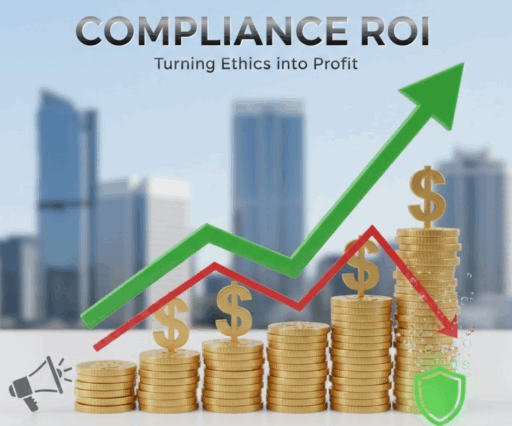
For decades, the corporate narrative regarding compliance has been defensive. It is viewed as a necessary evil, a cost center, or an insurance policy against the “what ifs” of regulatory doom. When budget season arrives, compliance officers often find themselves fighting for scraps, justifying their existence by pointing to hypothetical disasters avoided.
But this mindset is financially flawed; consider the compliance ROI.
It is time to flip the script. Compliance—specifically the mechanism of a robust, trusted whistleblower hotline—is not a drain on resources; it is a profit protection mechanism. By shifting the focus from “the cost of silence” to “the financial value of a timely report,” organizations can demonstrate that a functioning ethics program contributes directly to the bottom line.
The Economics of Duration: Time is Money
The Association of Certified Fraud Examiners (ACFE) consistently reports that the typical organization loses 5% of its revenue to fraud each year. For a company with $100 million in revenue, that is $5 million in lost profit.
The single biggest variable in that equation is time.
The financial damage of fraud or misconduct is rarely a lump sum event; it is a bleed. A payroll scheme, a vendor kickback, or an FCPA violation accumulates cost over time. The longer it goes undetected, the higher the financial impact.
- The 18-Month Bleed: The average fraud scheme lasts 12 to 18 months before detection.
- The Tip Advantage: Schemes detected by tip are shut down significantly faster—often 50% faster—than those detected by audit or accident.
The “Loss Avoidance” Calculation – Compliance ROI
To turn compliance into a profit center, you must quantify what didn’t happen. This is Loss Avoidance.
Consider a procurement fraud scheme bleeding the company $20,000 a month.
- Without a Hotline: The scheme runs the average duration (18 months). Total Loss: $360,000.
- With a Trusted Hotline: A report comes in at month 3. The scheme is stopped. Total Loss: $60,000.
The Profit: The compliance program just generated $300,000 in retained revenue. That is not “saved” money; that is capital that remains on the balance sheet, available for reinvestment, dividends, or growth.
The Regulatory Multiplier
Beyond direct loss, the Department of Justice (DOJ) and regulatory bodies worldwide have made the financial incentives for compliance explicit. Under current enforcement policies, companies that voluntarily self-disclose misconduct (which requires knowing about it first) and have effective compliance programs are eligible for massive reductions in fines.
A timely report allows a company to:
- Avoid the appointment of an external monitor.
- Qualify for “declinations” (where the DOJ declines to prosecute).
- Reduce fines by up to 50-75% off the low end of sentencing guidelines.
In this context, an early report is a discount coupon worth millions of dollars.
Practical Steps: Calculating and Presenting Compliance ROI
To present compliance as a profit driver to the Board or C-Suite, move away from activity metrics (e.g., “we had 10 calls”) and toward value metrics.
- The “Projected Loss” Model
When a substantiated report closes a case, calculate the annualized run rate of the loss.
Formula: (Monthly Loss x Average Duration of Similar Undetected Frauds) – Actual Loss = Compliance ROI
- The Asset Recovery Metric
Track the actual dollar amount recovered due to hotline reports. This includes restitution, insurance claims successfully filed because of documented evidence, and stoppage of leakage.
- The Litigation Avoidance Value
Work with legal counsel to estimate the cost of litigation for harassment or discrimination suits. Compare the settlement costs of cases caught early (internally resolved) versus those that go to court. The delta is your profit.
The Critical Tool: Independent Reporting
None of this financial value is realized if the phone doesn’t ring. The ROI of a hotline is entirely dependent on trust. If employees believe the line is monitored internally by the very people they might be reporting, they will remain silent, and the financial bleed will continue.
To maximize the “profitability” of reporting, organizations must utilize independent, third-party providers. While these providers do not conduct the internal investigation—that remains the responsibility of management or outside counsel—they perform a critical “triage” function that internal systems cannot replicate.
The Firewall Effect The primary value of an independent provider is the assurance of safe routing. When a report is filed internally (e.g., an email to HR), there is a risk that the report lands in the inbox of the very person being accused. An independent provider acts as a neutral screener. They receive the intake, review the details, and ensure the report is routed to the appropriate party who is not conflicted.
This layer of separation guarantees anonymity and safety for the whistleblower. It creates the psychological safety necessary for employees to speak up early, transforming the hotline from a “snitch line” into a trusted “early warning radar” that protects the company’s bottom line.
Conclusion: The Bottom Line
A report filed today is cheaper than a lawsuit filed tomorrow. A scam detected in month two is infinitely more profitable than a scam detected in month twenty.
Executives must stop asking, “How much does this hotline cost?” and start asking, “How much money is our silence costing us?” By reframing reporting as a tool for Loss Avoidance and Asset Retention, compliance, with its compliance ROI, transforms from a cost center into a strategic partner in profitability.
Learn how we can help you via an effective and affordable hotline solution. Contact us.
Want to learn more about Compliance ROI? See the article here.
Reach Us
Red Flag Reporting
P.O. Box 4230, Akron, Ohio 44321
Tel: 877-676-6551
Fax: 330-572-8146