
What is the Fraud Triangle? Definition, Elements, and Fraud Prevention
Fraud is intentional. Unlike errors, which are unintentional, fraud occurs when an individual deliberately acts to deceive — and it typically occurs when the right conditions align. Understanding those conditions is one of the most powerful tools compliance professionals have. The fraud triangle is a framework that helps explain why individuals commit occupational fraud and, more importantly, what organizations can do to prevent it. Whether you’re a compliance officer, internal auditor, risk manager, or board member, the fraud triangle gives you a structured way to assess exposure and strengthen controls.
What is the Fraud Triangle?
Definition and Overview
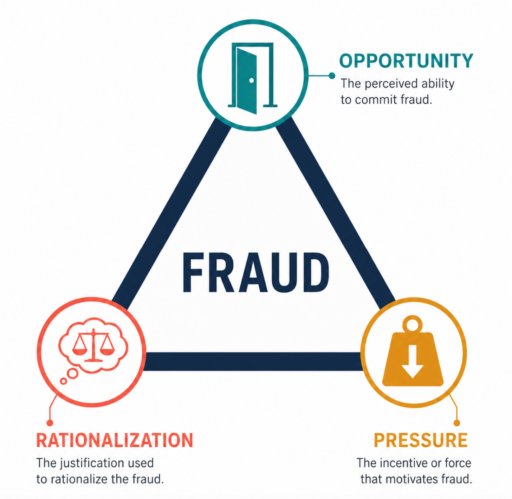
The fraud triangle is a model that identifies three conditions that commonly converge in occupational fraud — and that, when present together, significantly elevate the risk that an individual will commit fraud: opportunity, pressure (also called incentive or motivation), and rationalization. Reducing any one of these elements typically reduces overall fraud risk — and addressing all three creates a substantially more resilient control environment. This makes the fraud triangle not just a diagnostic tool, but a practical framework for designing and evaluating anti-fraud controls. The fraud triangle does not explain every scenario — predatory fraudsters and certain edge cases do not fit neatly within the model — but it remains one of the most widely used frameworks for occupational fraud risk assessment.
When all three elements are present, even an otherwise trustworthy employee can cross the line into fraud. That’s what makes the model so valuable: it shifts the conversation from “who is a bad actor” to “what conditions are we creating or allowing.”
Origins and Why the Framework Still Matters
The fraud triangle was developed by criminologist Donald Cressey in the 1950s, based on his research into why trusted employees commit financial crimes. His findings — published in Other People’s Money — introduced the idea that fraud is not simply a character flaw but a predictable response to a specific set of circumstances.
Decades later, the framework remains foundational in accounting, auditing, and compliance. The Association of Certified Fraud Examiners (ACFE) has built much of its professional guidance around the fraud triangle model, and auditing standards address fraud risk factors in terms that closely align with the fraud triangle. For issuers, PCAOB AS 2401 explicitly describes incentives/pressures, opportunities, and rationalization/attitudes as conditions generally present when fraud occurs. In the US nonissuer context, AU‑C 240 is commonly discussed in similar fraud-risk-factor terms when assessing the risk of material misstatement due to fraud.
Its staying power comes from its simplicity and accuracy. Organizations that move beyond reactive fraud response to proactive prevention cite the fraud triangle as the foundation of their risk assessment thinking.
The Three Elements of the Fraud Triangle
Many occupational fraud cases — including expense reimbursement fraud, financial statement manipulation, and embezzlement — involve a convergence of opportunity, pressure, and rationalization. Understanding each element helps compliance teams identify where their controls are strongest and where gaps remain.
1. Opportunity
Opportunity refers to the conditions that make it possible for fraud to occur — and go undetected. Weak internal controls, inadequate oversight, poor segregation of duties, and limited detection mechanisms all create opportunity. So does a culture in which employees believe misconduct is unlikely to be reported or investigated.
This is the element organizations have the most direct ability to address. Unlike pressure (which may stem from an employee’s personal life) or rationalization (which is internal and invisible), opportunity is shaped largely by the systems, processes, and culture an organization creates. Strengthening controls, increasing oversight, and — critically — ensuring that employees have a trusted, confidential channel to report suspected misconduct all reduce opportunity directly.
Increasing the perceived likelihood of detection can deter misconduct, and reporting channels play a key role in that deterrence. When employees believe that misconduct is likely to be caught and reported, opportunity shrinks.
2. Pressure
Pressure — sometimes called incentive or motivation — refers to the personal or professional circumstances that push an individual toward fraud. Financial stress is the most commonly cited driver: overwhelming personal debt, medical expenses, or sudden financial hardship can create a sense of desperation that overrides normal ethical constraints.
But pressure isn’t always financial. Performance-related pressure — such as unrealistic sales targets, fear of job loss, or pressure to hit quarterly numbers — can be equally powerful. So can personal pressures like substance abuse, gambling addiction, or family instability.
Organizations cannot always control the external pressures employees face. But they can monitor warning signs, create environments where employees feel safe raising concerns, and ensure that internal expectations are realistic rather than coercive. Employee Assistance Programs (EAPs) and open-door communication cultures are meaningful tools in reducing pressure-driven fraud risk.
3. Rationalization
Rationalization is the internal justification an individual uses to make fraudulent behavior feel acceptable or even deserved. Common rationalizations include: “I’ll pay it back,” “They owe me this,” “Everyone does it,” “The company can afford it,” or “No one is really hurt by this.”
Rationalization rarely looks like a clear choice to do wrong. More often, it’s a slow erosion of ethical boundaries — particularly in environments where small violations go unaddressed, where leadership doesn’t model ethical behavior, or where employees feel undervalued or mistreated.
The most effective organizational response to rationalization is the combination of a strong ethical culture, a clear and enforced code of conduct, and visible leadership commitment to integrity. When people see that ethical behavior is taken seriously and violations are consistently addressed, it becomes harder to justify misconduct internally.
| How the Fraud Triangle Maps to Organizational Controls | |
| Opportunity | Independent fraud hotline, case management system, audit controls, segregation of duties |
| Pressure | Open communication culture, Employee Assistance Programs, realistic performance expectations |
| Rationalization | Clear code of conduct, consistent enforcement, visible ethical leadership |
The Fraud Triangle in Accounting and Compliance
How Auditors and Accountants Use the Framework
In accounting and auditing contexts, the fraud triangle is a standard tool for evaluating the risk of fraudulent financial reporting and misappropriation of assets. Auditors use it to structure their risk assessment process — examining whether any combination of opportunity, pressure, and rationalization appears present within the engagement.
For example, a company facing liquidity pressure and bonus-driven performance targets (pressure), with a recently vacated internal audit function and weak segregation of duties (opportunity), where leadership has a history of normalizing “aggressive” accounting or dismissing concerns (rationalization) would immediately flag for heightened scrutiny under a fraud triangle analysis. This structured thinking helps auditors allocate attention and testing where it matters most.
How Compliance Teams Apply the Fraud Triangle
For compliance professionals, the fraud triangle extends well beyond financial statements. It applies to every area of organizational risk — procurement fraud, bribery and corruption, conflicts of interest, expense fraud, data theft, and more.
Compliance teams use the framework to ask three core questions across the business:
- Are our controls and detection mechanisms sufficient to reduce opportunity to an acceptable level?
- Are there incentive structures, performance pressures, or organizational dynamics that might increase the likelihood of pressure-driven fraud?
- Does our culture, leadership behavior, and enforcement track record make it harder or easier for employees to rationalize misconduct?
The answers to these questions inform everything from control design to training priorities to investigation protocols — making the fraud triangle a living risk management tool, not just an academic concept.
Using the Fraud Triangle to Strengthen Fraud Prevention
Reducing Opportunity Through Detection and Reporting
Of the three fraud triangle elements, opportunity is where organizations have the greatest leverage. One of the most effective ways to reduce opportunity is to increase both the actual and perceived likelihood that fraud will be detected.
Strong internal controls and segregation of duties are foundational. But controls alone are not sufficient. The ACFE’s 2024 Report to the Nations found that 43% of cases were detected by a tip — more than three times the next most common detection method.
This is why anonymous reporting channels are among the most cost-effective fraud prevention investments available. A well-implemented fraud hotline gives employees, vendors, and third parties a safe, confidential way to report concerns — increasing the likelihood that early warning signs surface before fraud escalates into a material loss.
The deterrent effect is equally important. When employees know that a reporting channel exists and is taken seriously, the opportunity element of the fraud triangle shrinks — because the perceived risk of detection increases.
Addressing Pressure Through Culture and Communication
Organizations can reduce pressure-related fraud risk by creating environments where employees feel heard, supported, and treated fairly. This includes:
- Reviewing performance incentive structures to ensure they don’t inadvertently reward or encourage corner-cutting
- Offering Employee Assistance Programs that help employees navigate financial or personal crises before those pressures become acute
- Ensuring managers are trained to recognize early signs of financial stress or distress in their teams
- Creating open communication cultures where employees can raise concerns about unrealistic expectations without fear of retaliation
None of these measures eliminate pressure entirely. But they reduce the likelihood that pressure builds to the point where it intersects with opportunity and rationalization.
Reducing Rationalization Through Ethics and Accountability
Rationalization thrives in environments where ethical boundaries are unclear, inconsistently enforced, or undermined by leadership behavior. Reducing it requires consistent, visible commitment to ethical standards throughout the organization.
Practical steps include:
- Maintaining and regularly communicating a clear code of conduct that sets unambiguous expectations
- Ensuring that violations — at all levels of the organization — are investigated and addressed consistently
- Training employees not just on what the rules are, but on how to recognize ethical pressure and how to respond
- Modeling ethical behavior at the leadership level, since culture flows from the top
When employees see that the organization takes integrity seriously — and that misconduct has consequences — the internal justifications that fuel rationalization become much harder to sustain.
How Red Flag Reporting Supports Fraud Triangle Risk Reduction
A Fraud Hotline That Directly Reduces Opportunity
As an experienced hotline provider, Red Flag Reporting gives organizations an independent, confidential reporting channel that directly addresses the opportunity element of the fraud triangle. When employees, vendors, or third parties have a trusted way to report concerns — without fear of retaliation or identification — the window of opportunity for fraud to continue undetected narrows significantly.
Red Flag Reporting’s hotline is designed to maximize trust and accessibility. It offers 24/7 coverage, can accept anonymous reports, and operates as a third-party provider independent of the organizations it serves — so reporters can have confidence that their concerns will be documented appropriately. This independence is critical: internal reporting channels, however well-intentioned, can be compromised by the very relationships they are meant to monitor.
Our comprehensive hotline services are designed to support compliance and audit teams across a range of organizational sizes and industries.
Case Management Tools That Document and Track Fraud Concerns
Detection is only valuable if it leads to action. Red Flag Reporting’s case management system allows compliance and audit teams to log, investigate, and resolve reports in a consistent, auditable way. Reports can be tracked from intake through resolution, supporting organizations in demonstrating a consistent, defensible response process to regulators, auditors, and boards.
This documentation infrastructure supports not only individual investigations but also broader fraud risk assessment. Trends in report volume, categories, and resolution outcomes give compliance teams the data they need to evaluate whether their fraud triangle risk profile is improving over time.
Implementation and Next Steps
The fraud triangle is most valuable as an action framework, not just a conceptual model. If your organization has not recently assessed whether its controls, culture, and detection infrastructure adequately address all three elements of the fraud triangle, now is the time to do so.
Key questions to ask:
- Do we have an independent reporting channel that employees trust and use?
- Are our internal controls and audit functions actively reducing opportunity, or are there known gaps?
- Does our compliance program address pressure and rationalization — not just controls?
- Are we tracking and acting on reports in a way that is consistent, documented, and defensible?
Red Flag Reporting works with organizations across industries to implement the reporting infrastructure that makes fraud prevention real. Contact us today to learn how our fraud hotline and case management solutions can help your organization reduce opportunity — and close the gap in your fraud risk framework.
| The Fraud Triangle Shows That Opportunity Is the Element You Control Most Directly.
Red Flag Reporting provides the independent hotline and case management infrastructure that reduces opportunity by ensuring fraud has nowhere to hide. Learn how we can help. |
Frequently Asked Questions About the Fraud Triangle
| What is the fraud triangle and what are its three elements?
The fraud triangle is a framework developed by criminologist Donald Cressey that identifies three conditions that commonly converge in occupational fraud: opportunity (the ability to commit fraud without detection), pressure (the personal or professional motivation to commit fraud), and rationalization (the internal justification that makes fraudulent behavior feel acceptable). These three conditions commonly converge in occupational fraud cases — and reducing any one of them typically lowers overall fraud risk. The framework does not account for every scenario, but it remains the most widely used model for occupational fraud risk assessment. |
| How do organizations use the fraud triangle in fraud risk assessment?
Compliance professionals and internal auditors use the fraud triangle to evaluate whether their organization’s controls, culture, and detection systems adequately address each of the three elements. This means assessing whether opportunity is reduced through strong controls and reporting channels, whether incentive structures or organizational pressures create elevated risk, and whether the ethical culture makes rationalization harder to sustain. The fraud triangle is especially useful for prioritizing where to invest in fraud prevention resources. |
| Which element of the fraud triangle can organizations control most directly?
Opportunity is the element organizations have the greatest ability to influence. While pressure may stem from an employee’s personal circumstances and rationalization is an internal mental process, opportunity is shaped by organizational systems: internal controls, oversight structures, segregation of duties, and — critically — whether a trusted, confidential reporting channel exists. Organizations that invest in detection infrastructure directly reduce the opportunity element of the fraud triangle. |
| How does a fraud hotline reduce fraud risk under the fraud triangle model?
A fraud hotline reduces the opportunity element of the fraud triangle in two ways. First, it gives employees, vendors, and other stakeholders a safe, confidential channel to report suspected misconduct — increasing the actual likelihood that fraud is detected early. Second, it creates a deterrent effect: when employees know a reporting channel exists and is taken seriously, the perceived risk of detection rises, which itself reduces the opportunity for fraud to occur and continue undetected. ACFE research consistently shows that tips are the most common way fraud is detected. |
| Is the fraud triangle only relevant to accounting and financial fraud?
No. While the fraud triangle originated in the accounting context and is widely used in financial statement audits, it applies to all types of occupational fraud — including procurement fraud, bribery and corruption, expense fraud, data theft, and conflicts of interest. Compliance teams across all industries use the framework to evaluate fraud risk at the organizational level, examining whether controls, culture, and reporting infrastructure adequately address opportunity, pressure, and rationalization across every business function. |