
Fraud Risk Assessment: A Practical Framework for Detection and Prevention
Every organization faces fraud risk. The question is not whether fraud could occur, but where it is most likely to occur and whether your controls are strong enough to detect or prevent it—before it becomes a material event. A fraud risk assessment provides a structured answer to both questions, giving compliance, audit, and finance leaders the documented foundation they need to build effective detection and prevention programs.
What is a Fraud Risk Assessment?
Definition and Overview
A fraud risk assessment is a structured review of the areas and circumstances in which an organization is most vulnerable to fraud. It identifies the specific processes, functions, and relationships where fraud is most likely to occur, assesses the adequacy of existing controls, and documents gaps that require corrective action. The goal is to move from general awareness to a specific, documented understanding of risk—one that can be used to direct compliance resources, configure reporting systems, prioritize audits, and inform training programs.
When conducted effectively, a fraud risk assessment answers three foundational questions:
- Where in our organization could fraud occur?
- How likely is each identified risk, and what would the impact be?
- Are our current controls, monitoring, and reporting systems sufficient to address those risks?
Why Fraud Risk Assessments Matter
Organizations that skip or deprioritize fraud risk assessment often discover gaps only after fraud has occurred—when the cost is measured not just in financial loss but in reputational damage, regulatory scrutiny, and leadership accountability, often after the organization no longer controls the narrative.
Regulators and professional standards bodies treat proactive fraud risk management as a defining characteristic of an effective compliance program. The U.S. Department of Justice’s guidance on corporate compliance programs emphasizes that organizations should conduct regular assessments of their fraud and misconduct risks. The Association of Certified Fraud Examiners (ACFE) recommends fraud risk assessment as a cornerstone of any anti-fraud program, noting that organizations with strong risk assessment practices detect fraud faster and experience smaller losses.
Audit committees and boards increasingly expect management to demonstrate that fraud risk has been formally assessed and that controls reflect the findings. An undocumented or outdated assessment leaves the organization exposed—both to fraud itself and to the legal and governance consequences that follow.
Key Components of a Fraud Risk Assessment
Identifying Fraud Risk Areas
The first component of a fraud risk assessment is mapping the functions, processes, and relationships most vulnerable to fraud. This typically includes:
- Procurement and vendor management, where bid rigging, kickbacks, and conflicts of interest are common risks
- Financial reporting, where pressure to meet targets can create incentives for manipulation
- Expense management and reimbursement, which are frequent targets for misappropriation
- Third-party and partnership relationships, where oversight is often limited
- Payroll and HR processes, which can be exploited through ghost employees or falsified records
- Revenue recognition and contract management, particularly in industries with complex billing arrangements
- Data manipulation and unauthorized system access, including insider threats and vendor collusion in digital environments
- AI-assisted fraud schemes, where emerging tools are being used to fabricate documentation, impersonate vendors, or override approval controls
Identifying these areas also requires attention to external factors—macroeconomic pressures, industry-specific fraud trends, and shifts in the regulatory environment can all elevate the likelihood of fraud in particular areas. Compliance and audit have important perspectives, but operational leaders, finance teams, HR, and legal counsel often surface risks that would not be visible from a single function’s vantage point.
Assessing Likelihood and Impact
Once fraud risk areas are identified, each risk is evaluated along two dimensions: how likely it is to occur and how significant the potential harm would be if it did. This evaluation focuses on inherent risk—the level of exposure that exists before any controls are applied.
Likelihood assessments consider factors such as the strength of existing controls, the level of oversight in a given process, historical incidents, and the external environment. Impact assessments consider the potential financial loss, reputational damage, regulatory exposure, and operational disruption associated with each risk.
Many organizations formalize this using risk scoring models or heat maps to visualize prioritization across identified risks. Scoring risks across these dimensions allows compliance and audit teams to direct resources where the exposure is greatest—addressing high-likelihood, high-impact risks immediately while monitoring lower-priority areas over time.
Evaluating Existing Controls
A fraud risk assessment does not simply document where fraud could occur—it evaluates whether the organization’s current controls are adequate to address those risks. A key output of this step is an understanding of residual risk: the exposure that remains after existing controls are taken into account. Controls are reviewed to determine whether they exist, are current, and operate as intended in practice, not just on paper. The assessment examines:
- Transaction monitoring, approval workflows, and segregation of duties
- Reporting mechanisms that allow employees and third parties to surface concerns confidentially
- Prior audit findings or hotline reports that signal gaps not yet fully remediated
Control gaps identified during this phase become the action items that drive compliance program improvements.
Aligning Findings to Detection and Prevention Programs
Assessment findings should not sit in a report. They should directly inform the organization’s detection and prevention programs—including hotline intake categories, compliance training curricula, internal audit plans, and transaction monitoring protocols—with controls aligned to business objectives, risk appetite, and regulatory expectations. These programs should be continuously refined based on outcomes and reported data.
An organization that identifies procurement fraud as a significant risk, for example, should ensure that its reporting hotline has clear intake categories for vendor conflicts and bid manipulation, that procurement staff receive targeted training, and that its audit plan includes periodic review of vendor relationships and contract approvals.
Conducting a Fraud Risk Assessment
Who Should Be Involved
Effective fraud risk assessments are cross-functional. The core team typically includes compliance, internal audit, finance, legal, and HR, but operational leaders who understand day-to-day processes bring essential context. Senior leadership should be engaged to ensure that organizational priorities and risk appetite are reflected in the assessment.
Organizations sometimes engage external advisors—forensic accountants, compliance consultants, or specialized auditors—to provide objectivity, industry benchmarking, or expertise in areas where internal knowledge is limited. External engagement can be particularly valuable for organizations conducting their first formal assessment or responding to a significant organizational change.
How Frequently Assessments Should Be Conducted
A fraud risk assessment should be conducted on a regular cycle—typically annually—and updated whenever significant organizational changes occur, including:
- Mergers, acquisitions, or divestitures
- Entry into new markets or lines of business
- Leadership transitions, particularly in finance, compliance, or audit
- Significant changes in the regulatory environment
- System implementations or changes to financial processes
- Prior fraud incidents or internal investigation findings
Treating the fraud risk assessment as a living document—rather than a periodic compliance exercise—allows organizations to stay ahead of emerging risks rather than responding after the fact.
Documenting and Communicating Findings
Assessment findings should be documented in a clear, structured format that supports board and audit committee reporting. Documentation should capture identified risks, the assessment of likelihood and impact, existing control gaps, and the action items assigned to address each gap.
Results should be communicated to the stakeholders responsible for implementing improvements—not just filed as a compliance artifact. Compliance leaders, internal audit, and operational management all need to understand the assessment findings to translate them into meaningful change.
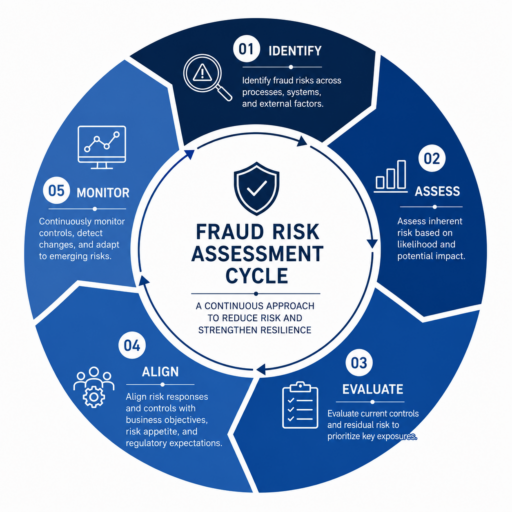
| The Fraud Risk Assessment Framework |
| • Identify — Map fraud risk areas across functions, processes, systems, and external factors |
| • Assess — Evaluate inherent risk based on likelihood and potential impact |
| • Evaluate — Review current controls and residual risk to prioritize key exposures |
| • Align — Align risk responses and controls with business objectives, risk appetite, and regulatory expectations |
| • Monitor — Continuously monitor controls, detect changes, and adapt to emerging risks |
Connecting Fraud Risk Assessment to Reporting Infrastructure
Aligning Hotline Categories to Identified Risks
One of the most practical applications of fraud risk assessment findings is configuring hotline intake categories to reflect the fraud types and risk areas the assessment identified. A generic hotline with broad intake categories may capture reports, but it creates friction—for reporters who are unsure where their concern fits and for investigators who must manually sort and route incoming disclosures.
When hotline categories are aligned to fraud risk assessment findings, reported concerns are captured and routed in a way that matches organizational risk. A compliance program that identifies financial reporting fraud, procurement irregularities, and conflicts of interest as significant risks should ensure its hotline has specific intake options for each of those categories.
Using Hotline Data to Monitor Fraud Risk Over Time
A fraud risk assessment captures risk at a point in time. Hotline reporting data provides ongoing, real-time visibility into whether identified risks are beginning to materialize.
Compliance and audit teams that regularly review hotline reporting trends can identify early signals—clusters of reports in a specific function, increases in a particular report category, or the emergence of a new concern type that was not anticipated in the last formal assessment. This intelligence allows organizations to adjust controls and investigative priorities between formal assessment cycles, rather than waiting for the next annual review to respond to a developing risk.
Supporting Investigations When Fraud Is Reported
When a hotline report surfaces a potential fraud concern, the organization needs a structured case management process to respond promptly, investigate thoroughly, document findings, and take corrective action. The fraud risk assessment framework provides the context that helps investigators assess the significance of a report and prioritize their response.
A well-designed case management system ensures that investigations are tracked consistently, documentation is preserved, and findings are communicated to the right stakeholders—including the board or audit committee when the severity of a case warrants it.
How Red Flag Reporting Supports Fraud Risk Assessment Programs
A Fraud Hotline Aligned to Your Risk Profile
As a trusted hotline provider, Red Flag Reporting provides a comprehensive reporting channel built around the fraud and compliance risks organizations face most. Our intake options are designed to comprehensively cover the financial and compliance risk areas that fraud risk assessments consistently identify—giving compliance and audit teams the structured intake data they need to detect and respond to concerns early.
An independent, third-party reporting channel also strengthens the credibility and accessibility of the reporting process. Employees and third parties are more likely to report concerns when they trust that reports will be handled confidentially and acted upon promptly—and when the reporting process is easy to navigate.
Case Management Tools That Connect Reports to Risk Findings
Red Flag Reporting’s case management system allows organizations to track fraud reports, document investigation steps and findings, and analyze reporting trends over time. This data supports ongoing fraud risk monitoring between formal assessment cycles, providing compliance and audit leaders with the information they need to make timely decisions about control adjustments and investigative priorities.
When a hotline report relates to a fraud risk area identified in the assessment, case management documentation creates a clear record connecting the reported concern to the organization’s known risk profile—supporting both investigation integrity and future assessment updates.
Implementation and Next Steps
A fraud risk assessment identifies where your organization is vulnerable. But vulnerability alone does not drive improvement—action does. The compliance controls, training programs, monitoring mechanisms, and reporting infrastructure that follow from assessment findings are what determine whether identified risks are effectively managed.
Red Flag Reporting’s hotline services are designed to support organizations at every stage of fraud risk management—providing the reporting infrastructure and case management tools that translate assessment findings into real detection and response capabilities.
Compliance and audit leaders are encouraged to contact Red Flag Reporting to evaluate whether your current reporting infrastructure is aligned to your highest fraud risks.
Frequently Asked Questions About Fraud Risk Assessments
| What is the purpose of a fraud risk assessment? |
| A fraud risk assessment is a structured review designed to identify where and how fraud could occur within an organization. Its purpose is to move beyond general awareness of fraud risk to a documented understanding of specific vulnerabilities—enabling compliance and audit leaders to direct controls, training, monitoring, and reporting resources toward the areas of greatest risk. |
| What does a fraud risk assessment deliver? |
| A completed fraud risk assessment delivers several tangible outputs: a documented inventory of fraud risk areas specific to your organization, a prioritized view of those risks based on likelihood and potential impact, an evaluation of existing control gaps, and a set of action items to address those gaps. These outputs directly inform hotline configuration, training priorities, audit plans, and monitoring protocols—translating risk awareness into a practical program for detection and prevention. |
| How often should a fraud risk assessment be conducted? |
| Most organizations conduct formal fraud risk assessments on an annual cycle. Assessments should also be updated whenever significant organizational changes occur, such as mergers or acquisitions, entry into new markets, leadership transitions, major system implementations, or shifts in the regulatory environment. Treating the assessment as a living document—rather than an annual exercise—helps organizations stay ahead of emerging risks. |
| Who should be involved in a fraud risk assessment? |
| An effective fraud risk assessment requires cross-functional input. The core team typically includes compliance, internal audit, finance, legal, and HR, supported by operational leaders who understand day-to-day processes. Senior leadership should be engaged to ensure that organizational priorities and risk appetite are reflected. External advisors—such as forensic accountants or compliance consultants—may be engaged for objectivity or specialized expertise. |
| How does a fraud risk assessment relate to a compliance hotline? |
| Fraud risk assessment findings should directly inform how organizations evaluate and select their compliance hotline. A hotline whose intake options comprehensively cover the financial and compliance risk areas that assessments consistently identify ensures that reported concerns are captured and routed efficiently—without gaps that could allow early warning signals to go undetected. Hotline reporting data also provides ongoing visibility into whether identified risks are beginning to materialize—allowing compliance teams to adjust controls between formal assessment cycles. |
| What is the difference between a fraud risk assessment and an internal audit? |
| A fraud risk assessment is a forward-looking process that identifies where fraud could occur and evaluates whether existing controls are adequate to address those risks. Internal audit is a broader function that includes reviewing financial records, testing controls, and evaluating operational processes. While the two are closely related—and internal audit often plays a key role in conducting or supporting the fraud risk assessment—they serve distinct purposes. Assessment findings typically inform the internal audit plan, ensuring that audit resources are directed toward the areas of greatest fraud risk. |