
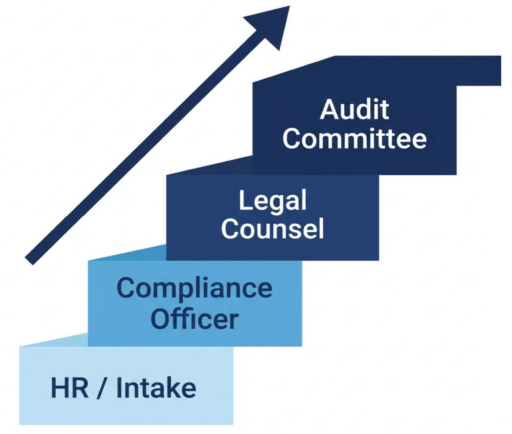
Escalation Matrix: The Essential Guide to Smarter Compliance Escalation
What is an Escalation Matrix?
An escalation matrix is a documented framework that defines when, how, and to whom a workplace report or compliance case must be elevated based on its severity, category, or potential risk level. Think of it as a decision tree embedded into your compliance program: when a concern arrives through a reporting channel, the escalation matrix removes guesswork by specifying exactly who should be notified, in what timeframe, and under what conditions.
Without this structure, even the most serious allegations can sit unresolved at the wrong level of an organization. A harassment complaint may stay with a front-line HR coordinator when it should immediately involve legal counsel. A fraud allegation may not reach the audit committee until weeks after initial intake. A well-built escalation matrix prevents those failures by turning escalation from a judgment call into a defined, repeatable process.
How an Escalation Matrix Fits Into a Compliance Program
An escalation matrix does not stand alone. It is one component in a broader compliance and case management framework that typically includes anonymous reporting channels, investigation protocols, corrective action procedures, and record-keeping requirements. The matrix sits at the intersection of intake and response: once a concern is received, the matrix determines what happens next.
This is why escalation matrices are closely tied to hotline intake systems and case management platforms. The information captured at intake, including the nature of the allegation, the identity or seniority of those involved, and the potential regulatory implications, directly determines which escalation path applies. A reporting system that collects incomplete intake data makes it harder to apply escalation rules consistently and accurately.
Why Escalation Matrices Matter in Compliance Programs
Ensuring Timely Response to High-Risk Matters
Time is often the difference between a contained compliance incident and an organizational crisis. When a report involving potential regulatory exposure or senior-level misconduct is not escalated promptly, the delay itself can become a liability. Regulators and courts have consistently held that how quickly an organization responds to a known concern is a meaningful indicator of compliance program effectiveness.
The U.S. Department of Justice’s Evaluation of Corporate Compliance Programs guidance explicitly asks whether a company’s compliance program ensures that information is escalated to appropriate decision-makers in a timely manner. A documented escalation matrix is direct, auditable evidence that the answer is yes.
Creating Consistency Across Cases and Teams
One of the most common and costly weaknesses in compliance programs is inconsistency. When escalation decisions are left to individual judgment, similar incidents may be handled very differently depending on who receives the initial report. One investigator escalates a harassment allegation to legal; another resolves an identical complaint at the HR level. These inconsistencies create legal exposure and, over time, erode the credibility of the entire compliance program.
A documented escalation policy eliminates that variability. When the rules are written down, reviewed by legal and HR, and embedded into case management workflows, the path a case travels is determined by the facts of the matter, not the instincts of the first person to open the file.
Supporting Defensibility and Audit Readiness
Organizations facing regulatory review, litigation, or internal audit are routinely asked to demonstrate how they responded to specific concerns. The ability to show that a report was received, triaged according to documented escalation procedures, routed to the appropriate authority, and resolved within defined timeframes is a powerful demonstration of program integrity.
A well-maintained escalation matrix, supported by case management records that document each escalation decision, creates exactly this kind of traceable, defensible record. Conversely, organizations that cannot show how escalation decisions were made face heightened scrutiny and reduced credibility with regulators, plaintiff counsel, and oversight bodies.
Key Components of an Escalation Matrix
| Key Elements of an Effective Escalation Matrix
• Clearly defined escalation triggers by case category and severity • Documented escalation tiers with named roles and responsibilities • Response timeframes for each escalation level • Notification and documentation requirements • Regular review and updates to reflect organizational changes • Training for investigators, managers, and compliance staff |
Escalation Triggers and Thresholds
Escalation triggers are the specific conditions that require a case to be elevated. Common triggers include the type of allegation (fraud, harassment, safety violation, retaliation), the potential financial impact of the underlying conduct, whether the subject of the report holds a senior position, whether regulatory obligations are implicated, and whether the matter may involve criminal liability.
Defining these triggers clearly is critical. Vague language like “serious” or “significant” introduces the same judgment-dependent variability that the escalation matrix is designed to eliminate. Effective matrices use specific, objective criteria that leave minimal room for interpretation.
Escalation Tiers and Responsible Parties
Most escalation matrices define three to five tiers, typically moving from the initial intake owner (often HR or a compliance coordinator) through functional leadership (HR director, compliance officer, general counsel) to senior executive and board-level oversight (CEO, audit committee, external counsel). Each tier should identify the responsible role by title, not by name, so the matrix remains accurate through personnel changes.
The matrix should also specify whether escalation to a higher tier supersedes or supplements the involvement of lower tiers. In most frameworks, escalation expands the circle of awareness rather than transferring ownership. The original handler retains responsibility for documentation and follow-through even after a case is elevated.
Timeframes and Response Expectations
Escalation without time-bound expectations is escalation without accountability. An effective escalation matrix defines how quickly escalation must occur at each tier, how long the receiving party has to acknowledge the matter, and what milestones apply to investigation and resolution timelines.
These service level expectations, sometimes called SLAs or response windows, should be calibrated to the risk level of each tier. A Tier 1 HR matter may have a 72-hour escalation window; a Tier 4 allegation involving a senior executive and potential securities violations may require same-day escalation to legal counsel and board notification.
Documentation and Notification Requirements
For each escalation event, the matrix should specify what must be recorded, who must be formally notified, and how those actions are captured. Minimum documentation standards typically include the date and time of escalation, the identity of the escalating party, the receiving party, the basis for escalation, and any immediate actions taken.
These records are typically maintained within a case management system, where they can be retrieved during audits or investigations. Organizations that rely on email threads or informal communications to document escalation decisions frequently find that those records are incomplete, inconsistently maintained, and difficult to produce under pressure.
Common Escalation Scenarios in Compliance Programs
Harassment or Workplace Misconduct Allegations
A harassment complaint typically enters the system at the HR level. However, the escalation matrix should define the specific conditions under which that complaint must be elevated. Reports involving a senior leader or executive, allegations of a pattern of behavior, complaints from multiple individuals about the same subject, or situations where the subject has authority over the investigation process are common triggers for escalation to legal counsel or the compliance function.
Failure to escalate harassment allegations appropriately is one of the more frequently cited compliance failures in employment litigation. Documented escalation rules, consistently applied, provide meaningful protection.
Fraud or Financial Misconduct Reports
Allegations involving financial irregularities, improper payments, expense manipulation, or vendor fraud typically require a different escalation path than HR-driven matters. Depending on the organization, financial misconduct reports may require early involvement from finance leadership, the general counsel, the internal audit function, and ultimately the audit committee.
Where the allegation involves potential violations of securities law, export controls, or anti-bribery regulations such as the Foreign Corrupt Practices Act, escalation to external counsel may be required at the outset. The escalation matrix should identify these categories explicitly and define the appropriate path.
Safety Violations or Regulatory Breaches
Reports involving potential safety violations, environmental incidents, or regulatory breaches often carry mandatory reporting obligations to external agencies. These situations require not just internal escalation but coordination with regulatory counsel to assess disclosure timelines and obligations.
The escalation matrix for these matters should specify that legal counsel is engaged simultaneously with internal escalation, rather than sequentially. Delays in regulatory notification, even when caused by internal escalation bottlenecks, can result in enforcement action independent of the underlying compliance failure.
Building an Effective Escalation Matrix
Aligning Escalation Rules to Risk Level and Case Category
An escalation matrix built around generic categories is less effective than one mapped to an organization’s specific risk taxonomy. Most compliance programs already maintain a catalog of the issue types most likely to arise in their reporting channels, based on industry, geographic footprint, and historical reporting patterns. That existing taxonomy should drive the structure of the escalation matrix.
For example, an organization operating in a heavily regulated industry may need more granular escalation rules for regulatory and safety matters than a professional services firm. The matrix should reflect the organization’s actual risk profile, not a generic template.
Involving Legal, HR, and Compliance in Matrix Design
The process of building an escalation matrix is itself a valuable exercise in cross-functional alignment. Legal, HR, compliance, and internal audit frequently have different assumptions about when matters should be escalated to them, and about their respective roles in the response process. A matrix design process that surfaces and resolves those differences creates a shared understanding that makes the finished document more likely to be followed consistently.
Senior leadership and the audit committee should also review and formally approve the escalation matrix. Their endorsement signals organizational commitment to the process and provides additional legal defensibility if escalation decisions are later scrutinized.
Training Staff and Investigators on Escalation Procedures
A documented escalation matrix that no one can apply in practice provides little protection. Training is not optional. Investigators, compliance coordinators, HR business partners, and managers who are likely to receive initial reports all need to understand the escalation rules and be able to apply them without extensive consultation.
Training should be specific enough to cover the most common escalation scenarios and refreshed when the matrix is updated. Organizations that conduct tabletop exercises or scenario-based training on escalation decision-making tend to achieve more consistent application of escalation procedures in practice.
How Red Flag Reporting Supports Escalation Matrix Implementation
Hotline Intake That Captures the Right Information for Triage
Applying escalation rules accurately requires complete, structured intake data. If the initial report does not capture the category of the allegation, whether the subject is a senior leader, or whether regulatory exposure is implicated, the escalation determination is being made on incomplete information.
Red Flag Reporting’s reporting channels are designed to collect the specific data points that compliance and HR teams need to triage incoming concerns against their escalation criteria. Structured intake forms, consistent data fields, and multilingual support ensure that the information needed to make an informed escalation decision is available from the moment a report is received.
Case Management Tools That Enforce Escalation Workflows
Documentation and workflow enforcement are where escalation policies either hold or fail. Red Flag Reporting’s case management system allows organizations to document their escalation procedures directly into the platform, assigning cases, routing notifications, tracking timeframes, and recording escalation decisions in a centralized, auditable system.
When every escalation action is captured in the case management record, the organization has the documentation it needs to demonstrate compliance program effectiveness to regulators, legal counsel, and the board. The result is not just better case outcomes but a more defensible and audit-ready compliance program overall.
Implementation and Next Steps
The first step toward a more effective escalation process is an honest assessment of what your organization has today. Are your escalation procedures written down and formally approved? Are they embedded in your case management workflows? Are investigators and HR staff consistently applying them? If the answer to any of those questions is unclear, that gap represents real organizational risk.
A hotline is only as effective as the escalation process behind it. Red Flag Reporting provides the reporting infrastructure and case management tools organizations need to ensure that every concern reaches the right people at the right time. If your organization is building or strengthening an escalation matrix, we are here to help.
| Ready to Strengthen Your Escalation Process?
Red Flag Reporting provides the reporting infrastructure and case management tools your organization needs to ensure every concern reaches the right people at the right time. Whether you are building an escalation matrix from scratch or looking to strengthen existing procedures, our team is ready to help. |