
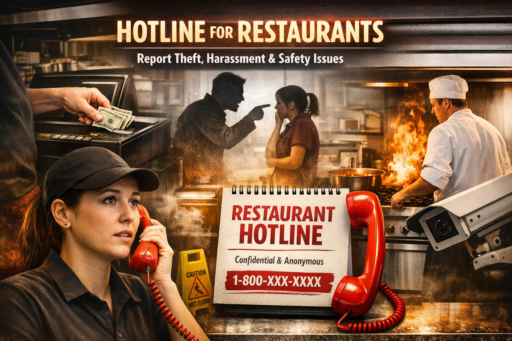
Hotline for Restaurants: 5 Powerful Reasons Every Food Service Operation Needs One
The restaurant industry is one of the most vibrant — and most vulnerable — sectors in the American economy. Thin profit margins, high employee turnover, fast-paced work environments, and a workforce that often feels powerless to speak up create conditions where misconduct can quietly flourish. For restaurant owners and operators, the question is no longer whether problems exist. The question is whether your employees have a safe, confidential way to report them before those problems destroy your business.
That is precisely where a hotline for restaurants becomes indispensable.
The Unique Risks Facing the Restaurant Industry
Before examining the solution, it helps to understand the scale of the challenge. The restaurant industry faces a constellation of compliance and misconduct risks that few other sectors share in the same concentration.
Employee Theft Is Pervasive and Costly
Internal employee theft accounts for 75% of restaurant inventory losses and 4% of restaurant sales, costing businesses an estimated $3 to $6 billion annually. Lightspeed The schemes range from the straightforward — a server pocketing cash from a voided transaction — to the sophisticated, such as accounting fraud, ghost employee schemes, and manipulated loyalty point systems. The profit margin in the restaurant industry is already narrow, with typical net profit margins averaging just 3–5%, which means even a modest theft loss can eliminate profitability entirely. Restroworks
Making matters worse, managers are not exempt from suspicion. 37% of total theft in restaurants is perpetrated by managers Mirus — the very people typically responsible for oversight. And because restaurant environments involve overlapping staff responsibilities, irregular hours, and heavy cash flow, fraudulent activity can go undetected for months or even years.
Harassment Is Alarmingly Common
The restaurant industry consistently ranks among the worst for workplace harassment. One study found that 90% of women who work in the restaurant industry reported being subjected to some form of sexual harassment, and even 70% of men reported being subjected to sexual harassment at their place of work in the restaurant sector. Contributing factors include power imbalances between managers and hourly workers, high turnover that normalizes dysfunction, and a “customer is always right” mentality that sometimes extends to tolerating customer harassment of staff.
The National Restaurant Association has recognized this challenge directly, developing specialized harassment prevention training through its ServSafe Workplace program. But training alone is not enough if employees have no trusted outlet to report violations when they occur.
Safety Violations Slip Through the Cracks
Commercial kitchens are hazardous environments. Burns, slips, chemical exposures, and equipment injuries are everyday risks. Yet OSHA inspections continue to find significant compliance shortfalls in restaurant settings. When employees are afraid to speak up about unsafe conditions — worried about retaliation or job loss — minor hazards can become major incidents. A culture of silence around safety issues is not just an ethical failure; it is a liability.
High Turnover Accelerates Every Risk
Data from the National Restaurant Association illustrates that food and dining has one of the highest turnover percentages among American business sectors, and more recent figures from the U.S. Bureau of Labor Statistics reported restaurants suffered an even higher 86.3% attrition rate in 2021. Qualee High turnover means new employees who haven’t internalized your values yet, exhausted managers who can’t monitor everything, and a revolving door that makes misconduct harder to track over time.
Why a Hotline for Restaurants Is the Right Tool
A compliance hotline is not just a phone number on a poster. It is a structured, third-party-operated system that gives every member of your team — from dishwashers to shift supervisors — a confidential, trusted way to report concerns about theft, harassment, safety violations, food safety issues, or any other unethical behavior, without fear of retaliation.
Here is why a hotline for restaurants specifically addresses the industry’s most pressing vulnerabilities.
- It Creates a Safe Channel When Power Dynamics Silence People
The single biggest barrier to reporting in a restaurant environment is fear. A server who witnesses their manager skimming cash may feel powerless to act, knowing their schedule, their tips, and their continued employment all depend on that manager’s goodwill. An anonymous, third-party hotline removes that barrier entirely. Employees can report what they see without identifying themselves — and without confronting management directly. This is especially critical in the restaurant context, where the person engaging in misconduct is often the same person an employee would otherwise have to report to.
- It Catches Theft Before It Becomes Catastrophic
The average time fraud goes undetected is two years, and cases lasting five or more years result in average losses of $2.2 million. JW Surety Bonds In an industry operating on margins of 3–5%, losses at that scale are existential. A hotline for restaurants dramatically shortens the detection window. Employees almost always know — or suspect — when something is wrong long before management does. Giving them a confidential path to report that suspicion means you can intervene early, when losses are still recoverable.
- It Helps You Address Harassment Before It Becomes Litigation
When an employee experiences harassment and has no safe reporting channel, the options narrow to silence or legal action. Neither outcome serves your organization. A well-promoted compliance hotline creates a documented, actionable pathway for harassment reports to be received, investigated, and resolved. This not only protects your employees — it protects your business. It demonstrates that your organization takes complaints seriously, which matters enormously in any subsequent employment litigation and provides what is sometimes called an “affirmative defense.”
- It Reinforces Food Safety Culture
We’ve previously written about how Red Flag Reporting serves as Your Partner in Food Safety, with a dedicated reporting option for food safety concerns. A hotline for restaurants extends this protection by ensuring that employees who observe temperature violations, contamination risks, improper handling, or shortcuts taken during a busy rush have a way to flag those issues confidentially. The cost of a foodborne illness outbreak — in legal liability, remediation, and reputational damage — dwarfs the cost of any compliance program.
- It Supports the Entire Compliance Picture
A hotline for restaurants is not a single-issue tool. It covers the full spectrum of workplace concerns: wage and tip disputes, discrimination, drug and alcohol violations, vendor irregularities, and more. In a single system, you create one trusted avenue for every kind of concern your workforce might encounter. This breadth is particularly valuable in multi-location restaurant groups, where a single franchise owner or regional manager may be engaging in misconduct across multiple sites before anyone connects the dots.
What Makes a Hotline Effective — and What Doesn’t
Not all hotlines are created equal. An internal hotline — one operated by your own HR department or management team — carries an inherent credibility problem. Employees are skeptical, understandably so, about whether a report to someone inside the organization will be handled objectively and kept confidential. The concern about retaliation doesn’t disappear just because an HR email address exists.
An independent, third-party hotline addresses this skepticism directly. When employees know their report goes through an outside organization that will ensure all concerns are documented and that the report will not be directly routed to the manager being reported, trust in the system increases significantly.
Other features that make a hotline genuinely effective include 24/7 availability (restaurant staff work nights, weekends, and holidays), multilingual support (essential in an industry with a diverse workforce), a web-based reporting portal in addition to phone access, and robust case management tools that allow your leadership team to track, investigate, and resolve reports systematically.
A Hotline for Restaurants Is Also an Investment in Culture
There is a tendency to think of compliance tools as defensive — something you put in place to minimize liability. That framing undersells what a hotline for restaurants actually does. When employees know they can speak up safely, they are more likely to stay engaged. They see evidence that management is genuinely committed to fairness and integrity. Over time, a hotline becomes part of a culture where ethical behavior is the norm — not because people fear punishment, but because the organization has made clear that honesty is valued and protected.
In an industry where retention is a constant struggle, a culture of integrity and psychological safety is a genuine competitive advantage.
Get Started with Red Flag Reporting
Red Flag Reporting has served organizations across industries for over sixteen years, providing comprehensive, affordable, and easy-to-implement compliance hotline services. Our system is simple to deploy, multilingual, available 24/7, and backed by experienced live operators who handle every report with professionalism and confidentiality.
If you operate a restaurant, a restaurant group, a food service management company, or any organization in the hospitality sector, we’d welcome the chance to talk with you about how a hotline for restaurants can protect your people, your reputation, and your bottom line.
Contact us today — no pressure, just a straightforward conversation about whether our services are the right fit for your organization.