
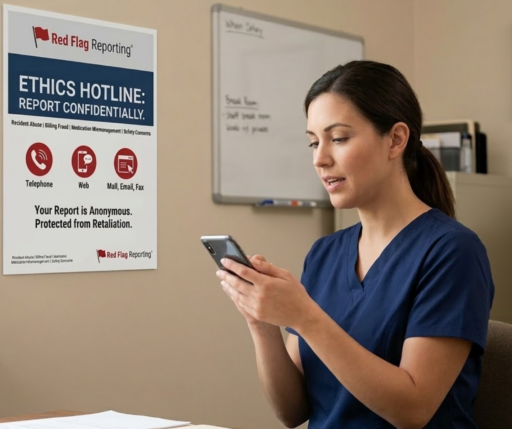
Ethics Hotline for Long Term Care Facilities: Protecting Residents, Staff, and Your Organization
By Red Flag Reporting | Compliance & Ethics | 8 min read
Long Term Care Facilities operate at the intersection of healthcare, finance, and human dignity. With vulnerable residents, complex regulatory requirements, and a workforce under constant pressure, the need for a structured, confidential ethics hotline has never been greater.
Why Long-Term Care Facilities Face Unique Compliance Risks
The long-term care industry is one of the most heavily regulated sectors in the United States — and for good reason. Residents are often elderly, cognitively impaired, or physically dependent, making them among the most vulnerable populations in our society. This vulnerability creates opportunities for misconduct that can go undetected without the right reporting infrastructure in place.
From Medicaid billing fraud to resident abuse and neglect, the range of potential violations is broad. Federal oversight from the Centers for Medicare & Medicaid Services (CMS), combined with state licensing boards and the False Claims Act, means that compliance failures don’t just carry moral weight — they carry significant legal and financial consequences.
According to the U.S. Department of Health and Human Services Office of Inspector General (OIG), long-term care providers consistently rank among the highest in fraud and abuse enforcement actions. In recent years, billions of dollars have been recovered in settlements tied to nursing home billing fraud, kickbacks, and inadequate care standards.
| $5.7B+
Healthcare‑related False Claims Act recoveries in FY2025
|
~15,000
Medicare/Medicaid-certified nursing facilities in the U.S. |
43%
Of fraud tips come from employees |
What an Ethics Hotline for Long Term Care Facilities Should Address
A well-designed ethics hotline for Long Term Care Facilities does far more than collect complaints. It creates a documented, confidential channel through which staff, residents, family members, and vendors can report concerns — without fear of retaliation. Here are the critical issue areas it should cover:
- Resident abuse and neglect — physical, emotional, sexual, and financial exploitation by staff or other residents
- Billing and coding fraud — upcoding, billing for services not rendered, or misuse of Medicare and Medicaid funds
- Medication diversion and mismanagement — theft or improper administration of controlled substances
- Staffing fraud — falsifying staff-to-resident ratios, credential misrepresentation, or ghost employees
- Kickbacks and referral schemes — improper financial relationships with physicians, pharmacies, or other providers
- HIPAA violations — unauthorized disclosure of resident health information
- Workplace safety concerns — unsafe conditions, understaffing emergencies, or infection control failures
- Financial exploitation of residents — theft of personal funds, property, or manipulation of estates
The Culture Problem: Why Silence Is So Common in Long-Term Care
One of the most pressing challenges in nursing homes and assisted living environments is the culture of silence that often surrounds misconduct. Certified nursing assistants (CNAs), who provide the majority of direct resident care, are often the first to witness problems — yet they are also among the least empowered to speak up through formal channels.
Fear of retaliation is real. Staff may worry about losing their jobs, damaging relationships with supervisors, or being labeled as troublemakers in a tight-knit workplace. Family members of residents may fear that speaking up will lead to retaliatory neglect of their loved one. These fears are understandable — and they are exactly why an anonymous, third-party ethics hotline is so valuable.
When employees know there is a safe, confidential way to report what they see, they are significantly more likely to come forward before small problems become major violations — or tragedies.
A third-party ethics hotline for Long Term Care Facilities removes the internal power dynamics from the equation. Reporters can share concerns without revealing their identity, and organizations receive the information they need to investigate and act — before regulators or law enforcement become involved.
Regulatory note: CMS’s Compliance and Ethics Program guidelines for long-term care facilities specifically encourage the use of anonymous reporting mechanisms. Facilities with strong compliance programs — including hotlines — are better positioned during audits, surveys, and enforcement reviews.
The Business Case: An Ethics Hotline for Long Term Care Facilities Pays for Itself
Compliance is sometimes treated as a cost center, but the math tells a different story for long-term care organizations. A single False Claims Act settlement can run into the tens of millions of dollars. Survey deficiencies that result in civil monetary penalties, special focus facility designation, or termination from Medicare and Medicaid can be existential threats to a facility’s operation.
Beyond legal exposure, the reputational damage of a high-profile abuse case or fraud investigation can devastate census numbers and staff recruitment for years. Families choosing a nursing home or assisted living facility for a loved one are increasingly conducting due diligence online — and negative headlines are not forgotten.
An ethics hotline acts as an early warning system. When staff feel confident that their reports will be taken seriously, issues surface earlier, internal investigations are more effective, and the organization demonstrates a genuine commitment to doing the right thing. That commitment resonates with surveyors, families, and prospective employees alike.
Key benefits of a third-party hotline for long-term care providers:
- Documented evidence of a functioning compliance program — a key factor in OIG audits and CMS surveys
- 24/7/365 availability for reporters across all shifts — critical in round-the-clock care environments
- Multilingual support to serve diverse workforces, including non-English-speaking staff
- Whistleblower protections reinforced through a third-party, arms-length reporting structure
- Trend reporting that helps compliance officers identify systemic issues across a facility or portfolio
OIG Compliance Program Guidance and What It Means for Your Facility
The OIG has long emphasized that nursing facilities should maintain open lines of communication as a core element of an effective compliance program. This includes not only written policies, but accessible, operational mechanisms for reporting concerns — with explicit protections for those who come forward.
Facilities operating under Corporate Integrity Agreements (CIAs) are often explicitly required to maintain a compliance hotline and demonstrate its utilization to the OIG. Even facilities not under a CIA are wise to adopt these practices proactively — they signal good faith to regulators and can be a significant mitigating factor if violations do occur.
An ethics hotline for Long Term Care Facilities also complements mandatory reporting requirements. While staff may already be required by law to report certain incidents of abuse or neglect to Adult Protective Services or a state long-term care ombudsman, a hotline provides an additional, immediate internal channel that allows facilities to begin investigating and remediating issues in real time.
Choosing the Right Partner for Your Ethics Hotline
Look for a provider that offers true anonymity (not just confidentiality), detailed intake processes that capture actionable information, case management tracking, and robust reporting tools that help your compliance team identify patterns over time. The ability to receive reports via phone, web, and other methods ensures accessibility for your entire workforce — from administrative staff to frontline caregivers working overnight shifts.
Red Flag Reporting was built specifically for organizations that take compliance seriously. Our ethics hotline for Long Term Care Facilities is designed to be easy to use, rigorous in its documentation, and backed by a team that understands what’s at stake for your residents, your staff, and your organization.
Ready to Strengthen Your Compliance Program?
Protecting your residents and your organization starts with giving people a safe way to speak up. Red Flag Reporting makes it simple to implement a professional, confidential ethics hotline tailored to the long-term care industry.