
What is Corporate Governance? Accountability, Oversight, and Compliance
What is Corporate Governance?
Definition and Overview
Corporate governance is the system of rules, practices, and processes by which an organization is directed and controlled. It encompasses the relationships between leadership, the board of directors, shareholders, and other stakeholders—establishing who has authority, how decisions are made, and how accountability is maintained at every level.
At its core, corporate governance determines how an organization is run and on whose behalf. It sets expectations for ethical conduct, financial integrity, and strategic oversight that shape behavior both internally and in the eyes of regulators, investors, and the public.
Why Corporate Governance Matters
Strong corporate governance reduces the risk of misconduct, financial mismanagement, and regulatory failure. When governance structures are clearly defined and consistently applied, decision-making becomes more transparent, problems surface earlier, and the organization is better positioned to respond before small concerns become significant ones.
Poor governance creates conditions in which conflicts of interest go unchecked and misconduct is concealed rather than reported. The consequences range from regulatory penalties and reputational harm to institutional failure. Effective governance is not a formality—it is a foundational safeguard for the organization and everyone who depends on it.
Core Principles of Corporate Governance
While governance frameworks vary across industries and jurisdictions, several foundational principles appear consistently across recognized standards and regulatory guidance. These principles translate abstract governance expectations into concrete organizational behaviors.
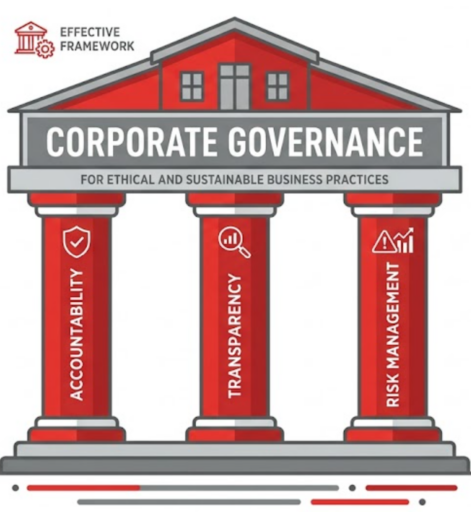
Accountability
Accountability is the obligation of leadership and the board to answer for organizational decisions and outcomes. It depends on structures that create visibility—independent oversight, effective reporting mechanisms, and documented decision-making processes. Without these, accountability remains aspirational rather than operational.
Transparency
Transparency requires organizations to be open about their operations, decisions, and outcomes with stakeholders who have a legitimate interest in them. It builds trust, reduces information asymmetries, and signals to regulators and the public that the organization has nothing to hide.
In practice, transparency depends on the organization’s willingness to surface concerns rather than suppress them. When employees know they can raise issues without fear of retaliation—and when those reports are acted upon by the organization—the commitment to transparency is demonstrated in practice, not just in policy.
Risk Management and Internal Controls
Effective governance requires organizations to identify, assess, and manage risk through structured controls, monitoring, and reporting systems. Risk management is a governance responsibility, reflecting the board’s obligation to protect the organization’s long-term interests.
Internal controls put governance principles into practice through policies that define acceptable conduct, monitoring systems that detect deviations, and reporting structures that bring relevant information to the people responsible for acting on it. A compliance program is one of the primary expressions of this function.
Corporate Governance and Compliance Programs
How Governance and Compliance Work Together
Governance sets the direction—the values, accountability structures, and oversight responsibilities an organization commits to. A compliance program is the mechanism through which those commitments are put into practice, delivering the policies, training, monitoring, and reporting systems that operate across the organization. Organizations that treat governance and compliance as separate functions tend to develop blind spots that neither oversight body is positioned to address.
The Role of the Board and Audit Committee
Boards and audit committees fulfill their governance responsibilities by overseeing compliance programs, reviewing reporting data, and ensuring that management is responding appropriately to identified risks. This oversight function requires that directors have access to accurate, timely information about the organization’s compliance posture—including data from internal reporting channels.
Audit committees carry specific responsibilities for financial oversight, fraud risk, and the integrity of internal controls. Reviewing hotline reporting data and compliance program metrics gives audit committees the visibility they need to fulfill these obligations in a meaningful, evidence-based way.
Regulatory Expectations for Governance and Reporting
Several major regulatory frameworks reinforce the expectation that organizations demonstrate governance through documented controls, independent oversight, and accessible reporting mechanisms.
The U.S. Sentencing Guidelines for Organizations identify an effective compliance and ethics program as a factor that can reduce culpability in the event of a violation—and specify that organizations must have mechanisms for employees to report potential wrongdoing without fear of retaliation. The Sarbanes-Oxley Act requires public companies to establish confidential reporting procedures for accounting and auditing concerns, placing direct responsibility on audit committees for overseeing those procedures. Dodd-Frank strengthened whistleblower protections and created financial incentives for reporting securities violations, underscoring the expectation that reporting channels will be genuinely accessible and protected.
Together, these frameworks signal that governance is evaluated not only on the policies an organization has adopted, but on whether those policies are supported by the operational infrastructure—including reporting systems—that makes them real.
Whistleblower Hotlines as a Governance Tool
Why Reporting Infrastructure Is a Governance Issue
Providing employees with a safe, independent channel to report concerns is widely recognized as a governance imperative—and for many organizations, a regulatory requirement. When an organization commits to surfacing misconduct rather than suppressing it, it demonstrates that its accountability structures function in practice, not just on paper.
Organizations that lack accessible reporting mechanisms—or that have channels employees don’t trust—are accepting governance risk. Concerns that cannot be safely raised internally tend to surface externally: through regulators, litigation, or media coverage. Investing in reporting infrastructure is an investment in the integrity of the governance system itself.
Third-Party Hotlines and Governance Independence
Using an independent, third-party hotline provider strengthens governance by ensuring that reports are received outside of the internal management chain and routed to the organization’s designated representative for follow-up. When employees report through an internal channel managed by the same leadership they may be reporting about, the structural independence of the process is compromised. An independent provider removes this conflict of interest and gives reporters confidence that their submission reaches the right people without internal interference.
Third-party independence also signals to regulators, auditors, and other stakeholders that the organization has made a genuine structural commitment to accountability.
Hotline Data as a Governance Input
Aggregated hotline reporting data gives boards and audit committees visibility into organizational risk, culture, and compliance posture that is otherwise hard to detect. Trends in report volume, subject matter, and resolution outcomes provide a real-time signal of where governance vulnerabilities may be developing.
When boards and audit committees regularly review hotline data as part of their oversight function, they make more informed, evidence-based governance decisions. This integration of reporting data into board-level oversight is recognized in governance standards as a marker of a mature, functioning compliance program.
If reporting infrastructure is central to governance effectiveness, the question becomes how organizations implement it in practice.
How Red Flag Reporting Supports Corporate Governance
Independent Hotline Services That Demonstrate Accountability
Red Flag Reporting operates as an independent, third-party hotline provider serving organizations across industries. Our hotline services give organizations a confidential, anonymous communication channel that operates entirely outside the internal management chain. Employees can raise concerns knowing their identity is protected and that their report will reach the organization’s designated representative—not be filtered through the same management structure they may be reporting about.
For boards, audit committees, and compliance officers, that structural independence is the foundation of a reporting channel employees will actually use—and that regulators and external stakeholders will recognize as a credible governance control.
Case Management Tools That Support Board-Level Oversight
Red Flag Reporting’s case management software gives organizations the infrastructure to track, document, and manage reports from intake through resolution. When a report comes in, it is routed directly to the organization’s designated representatives, who are responsible for conducting the investigation. The case management system supports that process by providing a structured workflow, documentation trail, and reporting capabilities that keep compliance teams—and the boards and audit committees they support—informed at every stage.
Boards and audit committees can review aggregated reporting data to assess trends, monitor case status, and evaluate the overall health of the compliance program—making hotline data a practical, meaningful input to governance oversight.
Implementation and Next Steps
If your reporting infrastructure can’t withstand board-level scrutiny, it’s not just a compliance gap—it’s a governance risk. Red Flag Reporting provides the anonymous communication channel and case management software that organizations need to receive reports independently, route them to the right people, and give leadership the visibility that effective governance demands.
Start a conversation today. Contact Red Flag Reporting →
| How Strong Corporate Governance Shows Up in Practice
• Active board and audit committee oversight of compliance data • Trusted, independent reporting channels used by employees • Consistent enforcement of clearly documented policies • Ongoing risk assessment with measurable follow-up • Regular board-level review of hotline trends • Transparent, documented resolution of reported concerns |
Frequently Asked Questions: Corporate Governance
- What is corporate governance and why is it important?
Corporate governance is the system of rules, practices, and processes by which an organization is directed and controlled. It defines how decisions are made, who is accountable for outcomes, and how stakeholder interests are protected. Effective governance reduces the risk of misconduct and financial mismanagement, builds trust with external stakeholders, and provides the structural foundation for accountability. Without strong governance, organizations are vulnerable to conflicts of interest, ethical failures, and regulatory penalties that can threaten long-term viability.
- What is the relationship between corporate governance and compliance?
Governance sets the expectations an organization commits to; compliance programs put those expectations into practice. The two functions are most effective when treated as integrated components of the same system. A compliance program without governance backing lacks organizational authority; governance commitments without compliance infrastructure remain aspirational. Organizations that align both functions develop stronger controls, better reporting, and more defensible oversight structures.
- What role does the board of directors play in corporate governance?
The board of directors is the primary governance body responsible for overseeing organizational leadership, strategy, and risk management. In the context of compliance, boards—and audit committees in particular—ensure that effective controls are in place, that management is responding to identified risks, and that reporting mechanisms are functioning. Regulatory frameworks including the U.S. Sentencing Guidelines and Sarbanes-Oxley explicitly recognize board and audit committee oversight as a core governance obligation, and expect boards to actively engage with compliance data rather than treating compliance as a delegated management concern.
- Why is a whistleblower hotline considered a corporate governance tool?
A whistleblower hotline is a governance tool because it provides the independent communication channel through which employees can safely raise concerns—without fear of retaliation and without their report passing through the management chain they may be reporting about. Reports are routed to the organization’s designated representative for investigation and follow-up. Regulatory frameworks including the U.S. Sentencing Guidelines, Sarbanes-Oxley, and Dodd-Frank specifically recognize confidential reporting mechanisms as indicators of effective governance and compliance infrastructure.
- What is the difference between an internal hotline and a third-party hotline provider?
An internal hotline is managed within the organization, typically by human resources, legal, or compliance. A third-party hotline provider operates independently, receiving reports outside the internal management chain and routing them to the organization’s designated representative for review and investigation. The governance advantage is structural: employees are more likely to report when they trust that their submission won’t be filtered or suppressed internally, and that their anonymity is protected by an independent party. Many governance frameworks and regulatory guidance documents specifically recommend independent reporting channels for this reason.
Further Reading
For a comprehensive overview of corporate governance principles and frameworks, the OECD Principles of Corporate Governance provide an internationally recognized reference for boards, policymakers, and governance professionals.
| If your reporting infrastructure can’t withstand board-level scrutiny, it’s not just a compliance gap—it’s a governance risk.
Red Flag Reporting provides the anonymous communication channel and case management software that give organizations the independent reporting infrastructure their governance obligations demand—routing concerns directly to your designated representative while giving leadership the visibility to act. |