High-Tech Social Engineering Prevention in 2026
In the landscape of 2026, the traditional image of a “security breach” has shifted. We no longer just picture a lone hacker in a dark room trying to brute-force a password. Instead, the most sophisticated threats today involve a friendly voice on the phone that sounds exactly like your CEO, or an urgent video message from a department head that looks indistinguishable from the real thing.
As organizations audit their strategies for social engineering prevention in 2026, it is becoming clear that the technical “perimeter” is stronger than ever. Encrypted servers, multi-factor authentication, and advanced AI-driven firewalls have made direct digital break-ins difficult. Consequently, bad actors have pivoted back to the oldest vulnerability in existence: the human element. For Compliance and Safety teams, this shift means that cybersecurity is no longer “just an IT problem.” It is a fundamental issue of organizational integrity and fraud prevention.
The New Frontier of Social Engineering Prevention: 2026 AI Threats
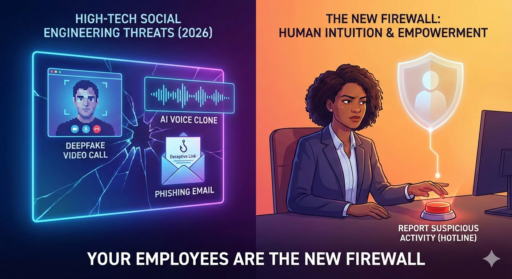
We have entered an era where “High-Tech Social Engineering” is the standard. These aren’t the poorly spelled phishing emails of a decade ago. Today’s threats leverage generative AI to create a sense of realism that can bypass even the most skeptical employees. Effective social engineering prevention in 2026 must address three specific AI-driven tactics:
- AI Vishing (Voice Phishing): Using a few seconds of audio from a public speech or a LinkedIn video, hackers can clone a manager’s voice perfectly. They call an employee in accounting or operations, creating a sense of “executive urgency” to bypass standard verification protocols.
- Deepfake Instructions: A video message or a “quick Zoom call” where the image and voice of a leader are spoofed to authorize a change in vendor banking details or to share sensitive facility access codes.
- Contextual Social Engineering: Hackers now research internal company culture and recent successes to craft stories that make sense. They don’t just ask for money; they ask for “help with a confidential project” that fits the employee’s specific role.
When the “request” comes from a voice you recognize and trust, the logical part of the brain that looks for red flags often shuts down. This is why AI vishing awareness training is now as vital as any software update.
The Psychology of the Attack: Why Humans are Targeted
To protect an organization, Compliance and Safety leaders must understand the psychological triggers these criminals use. These aren’t technical exploits; they are emotional ones.
- The Authority Trigger Most employees are conditioned to be helpful and responsive to leadership. Hackers exploit this by impersonating high-level executives. When an employee believes they are speaking to the CEO, they are far more likely to “cut corners” or “skip a step” to prove their efficiency.
- Artificial Urgency “I need this done before the board meeting in twenty minutes.” By creating a time-crunch, the attacker prevents the employee from pausing to think. Under stress, humans revert to fast, autopilot thinking rather than slow, analytical verification.
- The “Confidential” Trap Attackers often tell the employee that the request is “highly sensitive,” which discourages the employee from mentioning it to their coworkers or immediate supervisor—the very people who could verify if the request is legitimate.
Building a “Verification Culture”
Since we cannot stop the technology from existing, we must train our teams to manage the human response. Training in 2026 should move away from boring slide decks and toward active verification habits. This is a cornerstone of modern social engineering prevention 2026 strategies.
- The “Pivot and Verify” Rule: Teach employees that it is never “insubordinate” to verify a high-stakes request. If a supervisor asks for a wire transfer or sensitive data via a phone call, the employee should be empowered to say, “I’ll get right on that, but I’m going to hang up and call you back on your internal extension to confirm the details.”
- Human Firewall vs. Technical Security: While your software blocks 99% of threats, that 1% that gets through requires a human firewall. Empowering employees to trust their intuition is the most effective way to close that gap.
The Critical Role of the “No-Fault” Hotline for Social Engineering Prevention in 2026
The greatest danger to an organization isn’t the initial click on a suspicious link or the 30-second conversation with a voice-cloned hacker. The greatest danger is the silence that follows. When an employee realizes, minutes or hours later, that “something didn’t feel right,” they often face a wave of panic and embarrassment. They worry about their job security or their reputation. In a high-pressure environment, that fear can lead them to hide the mistake, hoping no one notices. This silence gives the attacker hours, or even days, to move through your systems undetected.
By positioning your hotline as a “no-fault” reporting tool for security concerns, you change the dynamic.
Instead of framing the hotline only for “reporting bad behavior,” market it as a “Security and Integrity Support Line.” Encourage employees to call the moment they suspect a communication was fraudulent—even if they’ve already interacted with it.
Why a Hotline is Essential for Social Engineering Prevention in 2026:
- Anonymity Removes Embarrassment: An employee might be too embarrassed to tell their direct manager they were fooled, but they will report it anonymously to a third party.
- Early Detection: One report of a “weird call from the CFO” can allow your IT and Compliance teams to issue an organization-wide alert, stopping the same scam from hitting twenty other employees that afternoon.
- Independence: If the social engineering attempt involves a superior (or someone pretending to be one), an independent hotline provides a safe path for the employee to speak up without fear of retaliation.
Conclusion: Empowering the Human Element
In 2026, a “safe” organization isn’t just one with the most expensive software; it’s one with the most empowered people.
Compliance and Safety teams have a unique opportunity to lead this charge. By shifting the focus from “don’t make mistakes” to “report suspicions early and often,” you turn every employee into a sensor for the organization. When your team knows that the company values the truth over perfection, they will use the tools you’ve provided—like your hotline—to ensure the best possible social engineering prevention in 2026, protecting the bottom line, the company’s data, and their own coworkers from the ever-evolving world of high-tech fraud.
Learn more about Social Engineering here.
Learn how we can help you: contact us.
Reach Us
Red Flag Reporting
P.O. Box 4230, Akron, Ohio 44321
Tel: 877-676-6551
Fax: 330-572-8146